
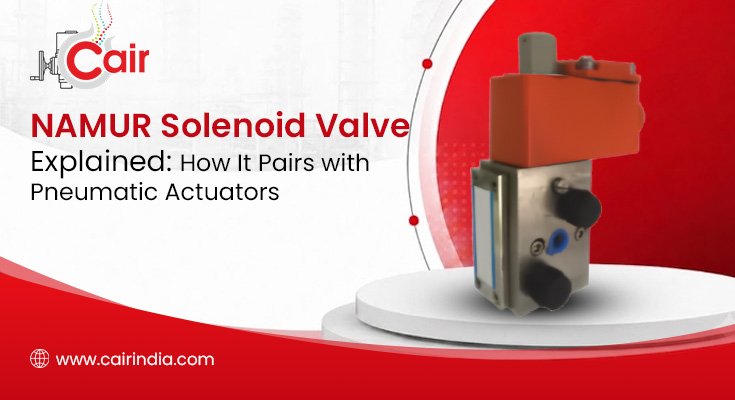
If you’ve ever stood next to a pneumatic actuator on a plant floor, you’ve probably noticed a small, boxy device bolted directly onto its side – no tubing running off to some distant control panel, no maze of fittings. That’s usually a NAMUR solenoid valve, and it’s doing more work than its size suggests. It’s the component that decides, in a fraction of a second, whether compressed air goes where it needs to go so your valve opens or closes on command.
For anyone specifying pneumatic valve automation – whether you’re a plant engineer, a procurement head, or an EPC contractor – understanding how this small accessory works (and why it’s built the way it is) can save you a lot of headaches down the line. Let’s break it down properly.
What Exactly Is a NAMUR Solenoid Valve?
A NAMUR solenoid valve is an electrically operated pilot valve that directs compressed air into a pneumatic actuator, causing it to rotate or stroke and, in turn, open or close the valve it’s mounted on. The “NAMUR” part of the name doesn’t describe the valve’s function – it describes its mounting interface.
NAMUR itself stands for the German industry group Normenarbeitsgemeinschaft für Mess- und Regeltechnik in der chemischen Industrie – essentially, a user association of automation professionals in the process industries. Decades ago, this group pushed for a standardized way to attach accessories like solenoid valves, limit switch boxes, and positioners directly onto actuators, regardless of who manufactured them. That standard is formally codified as VDI/VDE 3845, and it’s what people mean today when they say a valve or actuator is “NAMUR compliant” or “NAMUR mounted.”
Before this standard existed, connecting a solenoid valve to an actuator meant custom brackets, external tubing, and a dozen extra fittings – every one of which was a potential air leak. NAMUR mounting eliminated all of that by defining a common bolt pattern and port layout, so a solenoid valve from one manufacturer bolts straight onto an actuator from a completely different one.
If you want the fuller picture of how actuators work before or after the solenoid gets involved, our guide on valve actuators and their types is a good place to start.
How the Pairing Actually Works
Here’s the sequence, stripped down to essentials:
- A control signal (usually 24V DC, though other voltages are available) energizes the solenoid coil.
- The coil pulls a plunger, which shifts an internal spool.
- That shift redirects compressed air – either to one side of the actuator (single-acting, spring-return) or between two chambers (double-acting).
- The actuator moves, and the valve it’s connected to opens, closes, or throttles accordingly.
- When power is cut, a mechanical spring returns the spool to its default position – which is exactly why fail-safe behavior (fail-open or fail-close) is achievable with these systems.
The direct-mount design means the solenoid sits flush against a machined pad on the actuator body, with two O-ring-sealed ports aligning perfectly with the actuator’s air inlets. No copper tubing, no external brass elbows, no extra leak points. It’s a genuinely elegant solution to what used to be a messy installation problem.
This is also why pneumatic actuators remain a strong choice for fast, fail-safe shutoff applications, even as electric actuation continues gaining ground for precision control. We’ve compared the two approaches in detail in our electric vs pneumatic actuator guide, and gone even further with a three-way comparison including hydraulic actuation here.
3/2-Way vs 5/2-Way: Which One Do You Need?
This trips up a lot of first-time specifiers, so it’s worth clarifying:
| Feature | 3/2-Way NAMUR Valve | 5/2-Way NAMUR Valve |
| Ports | 3 | 5 |
| Used with | Single-acting (spring-return) actuators | Double-acting actuators |
| Air routing | One path pressurized, one path vented | Alternates pressure between two actuator chambers |
| Typical use case | Fail-safe applications (fire, emergency shutoff) | Applications needing full bidirectional control, no reliance on spring force |
If your process demands a valve that must return to a safe position on power or air loss – think emergency shutdown valves in a refinery – a 3/2-way valve paired with a spring-return actuator is usually the right call. If your actuator is double-acting and doesn’t rely on a spring for either direction, you’ll need a 5/2-way valve instead.
Why the NAMUR Interface Matters More Than People Realize
It’s easy to treat this as a minor mechanical detail, but the standardization has real, practical consequences:
Fewer leak points. Every fitting and length of tubing you remove from a pneumatic circuit is one less place for instrument air to escape. Direct-mount NAMUR valves cut this down to almost nothing.
Faster response times. Because the solenoid sits right on the actuator with no tubing in between, the air travel distance is minimal – which translates to quicker actuation, something that matters a great deal in fast-acting shutoff valves.
Interchangeability. A NAMUR-compliant solenoid from any manufacturer will physically fit a NAMUR-compliant actuator from any other manufacturer. For plants running mixed-brand equipment (which is nearly every plant), this drastically simplifies spares inventory and maintenance.
Lower installation cost and time. What used to require a fitter running tubing and mounting brackets is now a bolt-on job that takes a few minutes with a wrench.
Compatibility with other accessories. The same VDI/VDE 3845 standard also governs how positioners and limit switch boxes mount to the top of an actuator, so a fully NAMUR-compliant actuator can carry a solenoid on the side and a positioner or switch box on top, all using the same universal geometry.
Where NAMUR Solenoid Valves Are Actually Used
While refineries and chemical plants are the most obvious users, NAMUR solenoid valves show up across a surprisingly wide range of sectors – water treatment plants, irrigation and agricultural systems, HVAC damper controls, food processing lines, energy and power generation, and gas supply networks, to name a few. Anywhere a pneumatic actuator is doing the heavy lifting on a valve, there’s a good chance a NAMUR solenoid valve is sitting quietly beside it, waiting for its next control signal.
Selecting the Right One: A Few Practical Pointers
Before you specify a NAMUR solenoid valve for a project, it helps to nail down these basics:
- Actuator type first. Confirm whether your actuator is single-acting or double-acting – this determines whether you need a 3/2-way or 5/2-way valve.
- Voltage and coil type. Common options include 24V DC and 110/230V AC; make sure it matches your plant’s control philosophy.
- Flow rate. Larger actuators need faster air delivery to hit your required stroke time, so check the valve’s flow rating against your actuator’s chamber volume and desired response time.
- Environment. For hazardous areas, look for ATEX or flameproof-rated coils. For food or pharma applications, stainless steel bodies and FDA-compliant seals are usually non-negotiable.
- Manual override. A manual override lever lets technicians actuate the valve locally during testing or power loss, which is worth having on almost every installation.
- Certifications. Depending on your industry, you may need SIL-rated valves, CE marking, or other compliance documentation – always confirm this against your project spec before ordering.
If you’d like to see the technical specifications and variants Cair Euromatic manufactures, our NAMUR solenoid valve product page has the full details, and our complete product range covers everything from actuators to accessories if you’re sourcing a full automation package.
Final Thoughts
The NAMUR solenoid valve is one of those components that rarely gets much attention until something goes wrong – a slow-closing valve, a leaking fitting, or an incompatible accessory during a plant expansion. Understanding how it pairs with your pneumatic actuator, and why the mounting standard behind it exists, puts you in a much better position to specify, install, and maintain your valve automation setup correctly the first time.
If you’re still weighing pneumatic against electric actuation for a specific application, it’s worth reading through our comparison guides linked above before finalizing your choice – the right accessory only helps if you’ve already picked the right actuation technology for the job.
Got a specific application in mind? Reach out to our team, or browse our FAQ page for quick answers to common valve automation questions.