
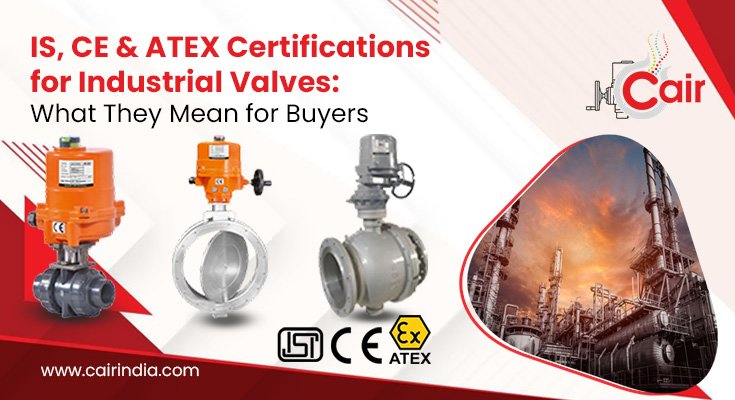
You’re evaluating valve suppliers for a new project. One vendor’s datasheet shows: ISO 9001 | CE | ATEX | IECEx | PESO | TÜV Nord | ISI Mark. Another shows: ISO 9001. A third shows nothing at all.
If you don’t know what each of those acronyms means – what they certify, what they require, and crucially, which ones actually matter for your specific application – you cannot make a meaningful comparison between those three options.
This guide exists to fix that. We’ll walk through every major valve certification used in industrial procurement in India and internationally – IS/BIS, CE marking, ATEX, IECEx, and PESO – explain in plain language what each one means, when it’s legally required versus optional, how to read certification markings, and what documentation you should ask for before signing a purchase order.
By the end, you’ll have the knowledge to evaluate valve certifications as a genuine quality signal – not just a logo on a datasheet.
Why Valve Certifications Actually Matter
Industrial valves control the flow of pressurised fluids, gases, chemicals, and steam in environments where a failure can mean a dangerous leak, a process shutdown, an explosion, or a fatality. Certifications exist because the stakes are too high to trust manufacturer claims alone.
A valve certification does three things:
- It confirms that an independent, accredited third party has verified the product against a defined standard – not just the manufacturer’s own claims
- It documents the scope of that verification – what was tested, under what conditions, to what performance criteria
- It establishes legal traceability – if a certified valve fails in service and causes harm, there is a clear audit trail of who certified it, under what standard
But certifications have limits too. As engineers and procurement specialists know: a certification is a permission to operate – it is not a guarantee of performance in every application. A CE-marked valve is not automatically the right valve for your application. An ATEX-certified actuator is not automatically explosion-proof in every zone. Understanding what each certification covers – and what it does not – is the difference between using certifications as genuine procurement tools and treating them as marketing decoration.
Important distinction: Certifications confirm that a product meets a defined standard under tested conditions. They do not replace application engineering – selecting the right valve type, size, pressure rating, and material for your specific process remains the engineer’s responsibility.
Certification 1: IS / BIS – Bureau of Indian Standards
IS / BIS – Bureau of Indian Standards
Scope: Product safety and performance standards for the Indian market – covers dimensions, materials, pressure ratings, and test procedures
Issued by: Bureau of Indian Standards (BIS), Government of India
Mandatory: Mandatory for products listed under Quality Control Orders (QCOs). IS 14846 is mandatory for sluice valves used in Indian waterworks.
The Bureau of Indian Standards is India’s national standards body. An IS (Indian Standard) certification – commonly called BIS certification – means the product has been tested against a specific Indian Standard and the manufacturing facility has been audited by BIS.
For valve procurement in India, the most important IS standard to know is:
IS 14846: Sluice valves for waterworks purposes – sizes DN50 to DN1200. This is a mandatory certification for sluice and gate valves used in municipal water supply and Jal Jeevan Mission projects. Government water authority tenders routinely require IS 14846 compliance as a pre-qualification criterion. A supplier without this certification cannot legally supply sluice valves for Indian government waterworks projects.
Other relevant IS standards in the valve context include IS 5312 (check valves for waterworks) and various IS standards governing valve materials, pressure testing, and flange dimensions.
How to Verify an IS Certification
Every BIS-certified product carries the ISI mark (the triangular logo) along with the licence number in the format CM/L-XXXXXXXX. You can verify this licence number on the BIS portal at bis.gov.in – confirming the manufacturer, product category, and licence validity. Never accept a BIS certificate without verifying the licence number on the portal.
→ Cair Euromatic holds ISI mark certification. View the full certification list at cairindia.com/certificates.
Certification 2: CE Marking – Conformite Europeenne
CE Mark – Conformité Européenne (European Conformity)
Scope: Confirms the product meets all applicable EU directives covering safety, health, environmental protection, and consumer protection – mandatory for placing products on the EU market
Issued by: European Commission framework – assessment by Notified Body (mandatory for high-risk products) or manufacturer’s own Declaration of Conformity (lower-risk products)
Mandatory: Mandatory for any product sold in the EU/EEA. Not required in India – but a strong indicator of quality for Indian buyers.
The CE mark is the EU’s unified product conformity marking. It signals that the product meets all applicable EU directives – not just one, but all that apply to that product category.
For industrial valves, CE marking typically indicates compliance with the Pressure Equipment Directive (PED 2014/68/EU) and, where relevant, the Machinery Directive (2006/42/EC) and the ATEX Directive (2014/34/EU). The applicable directives depend on the valve type, pressure class, and intended application.
What CE Marking Means for Indian Buyers
CE marking is not an Indian requirement – you don’t need CE-marked valves for an Indian plant unless you are supplying to a project that contractually requires it (EPC projects with European principals, pharma plants with EU GMP or FDA requirements, or export-oriented projects).
However, for Indian buyers evaluating valve quality, CE marking from a reputable Indian manufacturer is a genuinely meaningful quality signal. It means the manufacturer has been assessed by an independent EU-recognised Notified Body – not just self-declared compliance. The assessment covers design documentation, manufacturing process controls, and product testing. An Indian valve manufacturer that holds CE marking has demonstrated its quality systems can satisfy European regulatory scrutiny – which is more demanding than most domestic requirements.
Key document to request: Declaration of Conformity (DoC) – a formal document identifying the EU directives the product complies with, the applicable standards, the Notified Body involved, and the manufacturer’s authorised representative. Any CE-marked product must be accompanied by a DoC.
CE Marking vs. ISO 9001: They Are Not the Same
ISO 9001 certifies the manufacturer’s quality management system – it says the company follows a consistent process. CE marking certifies that a specific product meets specific EU technical safety standards. Both are important, but they measure different things. A manufacturer can hold ISO 9001 without producing CE-marked products. An Indian valve manufacturer holding both – like Cair Euromatic – has demonstrated quality at both the process level and the product level.
Certification 3: ATEX – Explosive Atmospheres (EU)
ATEX – ATmosphères EXplosibles – EU Directive 2014/34/EU
Scope: Certifies that electrical or mechanical equipment with its own ignition sources is safe for use in potentially explosive atmospheres containing flammable gases, vapours, mists, or combustible dust
Issued by: EU-recognised Notified Body (mandatory for Category 1 and 2 equipment). Manufacturer self-assessment permitted for Category 3.
Mandatory: LEGALLY MANDATORY in the EU for equipment installed in classified hazardous zones. Not legally required in India – PESO serves the Indian equivalent function.
ATEX is arguably the most misunderstood certification in industrial valve procurement. Let us demystify it completely.
ATEX comes from the French ‘ATmosphères EXplosibles’ – explosive atmospheres. The ATEX Directive (2014/34/EU) is EU law that requires any equipment with its own potential ignition sources to be certified safe before it can be installed in a hazardous area where flammable gases, vapours, or combustible dust may be present.
Which Valves Need ATEX Certification – and Which Don’t
This is where many procurement teams make errors. The key question is: does the valve have its own potential ignition source?
- Manual valves (ball, butterfly, gate, globe) – Generally do NOT require ATEX certification under the directive, because they have no electrical components and no internal ignition source. Some manufacturers ATEX-certify them anyway for commercial reasons, but it is not legally required.
- Electric actuated valves – The ATEX certification applies to the electric actuator (and the complete actuator-valve assembly). The actuator contains an electric motor, position sensors, and wiring – all potential ignition sources. ATEX certification of the actuator is MANDATORY for installation in EU hazardous zones.
- Solenoid valves – Must be ATEX certified if installed in classified zones. The solenoid coil is an electrical component and potential ignition source.
- Pneumatic actuators with solenoid – The pneumatic actuator itself is not an ignition source, but the solenoid valve controlling it must be ATEX certified.
Critical rule: ATEX certification applies to the complete assembly as installed. An ATEX-certified actuator mounted on a non-ATEX-rated valve may invalidate the certification of the assembly. Always specify ATEX requirements at the complete valve-actuator assembly level.
ATEX Zone Classification: Understanding Zones 0, 1, and 2
ATEX hazardous areas are classified by how frequently and for how long explosive atmospheres are present. This zone classification determines which equipment category is required:
| Zone (Gas) | Zone (Dust) | Explosive Atmosphere Present… | Required Equipment Category |
| Zone 0 | Zone 20 | Continuously or for long periods | Category 1G/D – highest protection |
| Zone 1 | Zone 21 | Likely during normal operation | Category 2G/D |
| Zone 2 | Zone 22 | Unlikely; only in abnormal conditions | Category 3G/D |
Reading an ATEX Marking: The Complete Decoder
Every ATEX-certified product must carry a standardised marking. Here is how to read it – using a complete worked example:
| Marking Element | Example | What It Means |
| CE Mark | CE | Conforms to EU directives – mandatory on ATEX products |
| Notified Body No. | 0344 | ID of third-party certification body that audited the product |
| Ex Symbol | Ex | Explosion protection – the product is certified for hazardous areas |
| Equipment Group | II | Group II = all surface industries (not mines). Group I = mines only. |
| Equipment Category | 2 | Category 1 = Zone 0/20, Category 2 = Zone 1/21, Category 3 = Zone 2/22 |
| Gas or Dust | G | G = Gas atmosphere. D = Dust atmosphere. |
| Protection Method | Ex d | Type of explosion protection (d = flameproof, i = intrinsic safety, e = increased safety) |
| Gas Group | IIB | IIA = propane / least sensitive. IIB = ethylene. IIC = hydrogen / most sensitive. |
| Temperature Class | T4 | Max surface temperature: T1=450°C, T2=300°C, T3=200°C, T4=135°C, T5=100°C, T6=85°C |
| Full Example | II 2G Ex d IIB T4 | Group II, Cat 2 (Zone 1), Gas, flameproof, ethylene group, max 135°C surface temp |
So a marking of ⬡ Ex II 2G Ex d IIB T4 tells you: this equipment is certified for EU surface industries (Group II), in Zone 1 gas areas (Category 2G), using flameproof protection (Ex d), for gases with explosion sensitivity up to ethylene (IIB), with a maximum surface temperature of 135°C (T4). Match each element to your site’s hazard classification before specifying.
Industries Where ATEX-Certified Electric Actuated Valves Are Required
- Oil refineries and petroleum storage terminals (Zone 1 and Zone 2 areas throughout)
- Chemical plants handling flammable solvents, hydrocarbons, or reactive gases
- Pharmaceutical plants with solvent handling or flammable material storage areas
- LNG and gas processing facilities
- Paint and coating manufacturing facilities
- Biogas plants and anaerobic digesters (methane – Zone 1/2 around fittings and valves)
- Flour milling and food processing facilities with combustible dust (Zone 21/22)
Cair Euromatic’s Explosion-Proof Electric Actuators are ATEX and IECEx certified – suitable for the full range of hazardous area valve automation applications across Indian and international projects.
Certification 4: IECEx – The Global Equivalent of ATEX
IECEx – International Electrotechnical Commission Explosive Atmospheres System
Scope: Global certification scheme for equipment used in explosive atmospheres – based on IEC 60079 series standards. Functionally equivalent to ATEX but internationally recognised outside the EU
Issued by: IECEx Certification Body (ExCB) – accredited by the IECEx secretariat. All IECEx Certificates of Conformity (CoC) are publicly listed at iecex.com
Mandatory: Voluntary globally – but widely required in Middle East, Australia, India (as basis for PESO), and increasingly mandated in project specifications.
IECEx is the international system for explosion protection certification. While ATEX is EU law, IECEx is a voluntary global scheme based on the IEC 60079 series of standards – the same technical standards that ATEX is harmonised with. The protection concepts (Ex d, Ex e, Ex i, etc.) and the zone classification system are identical.
IECEx vs ATEX: When Does Each Apply?
ATEX: Required by law for equipment installed in EU/EEA hazardous areas. CE marking must accompany ATEX certification. Products must display the ATEX-specific marking format including CE + Notified Body number.
IECEx: Voluntary globally, but widely specified in project contracts in the Middle East (UAE, Saudi Arabia), Australia, New Zealand, Singapore, India (as the accepted basis for PESO approval), and Africa. No CE marking required – IECEx issues a Certificate of Conformity (CoC) listed publicly at iecex.com.
For Indian manufacturers exporting to international projects, IECEx is typically the first certification to obtain – it is accepted in more markets and the technical requirements are identical to ATEX. Many manufacturers hold both ATEX and IECEx (dual certification) to cover both EU and non-EU markets from a single product design.
Verification tip: All IECEx Certificates of Conformity are publicly searchable at iecex.com. Enter the certificate number from the product datasheet to verify the certificate is current, genuine, and applies to the product you are purchasing. This is the most reliable way to verify IECEx compliance.
IECEx and India
India uses IS/IEC 60079 – the Indian adoption of the IEC 60079 series – as its national standard for explosion-protected equipment. For Indian hazardous area applications, IECEx certification is accepted as the technical basis for PESO (Petroleum and Explosives Safety Organisation) approval. An IECEx certificate significantly simplifies the PESO application process for imported or Indian-manufactured equipment.
Certification 5: PESO – India’s Hazardous Area Authority
PESO – Petroleum and Explosives Safety Organisation
Scope: Indian statutory approval for equipment used in petroleum, gas, and explosives service in India – covers storage, handling, and processing of petroleum products and flammable gases under the Petroleum Rules 2002 and Explosives Act
Issued by: Petroleum and Explosives Safety Organisation (PESO), Government of India – under Ministry for Promotion of Industry and Internal Trade (DPIIT)
Mandatory: MANDATORY for petroleum-service and gas-handling equipment in India under the Petroleum Rules 2002. Required for oil refineries, petrochemical plants, gas distribution, and explosive-risk industrial sites.
PESO is India’s statutory authority for petroleum and explosive safety. If you are specifying valves – particularly electric actuated valves – for Indian oil refineries, gas processing plants, petrochemical facilities, or any site classified as petroleum service under the Petroleum Rules 2002, PESO approval is not optional. It is a legal requirement.
PESO vs. ATEX/IECEx: How They Relate
PESO does not issue its own technical standards from scratch. Instead, PESO accepts international certifications – primarily IECEx and ATEX – as the technical basis for its own approval, and then conducts an administrative review of the certification documentation, technical files, and manufacturing information.
In practice, an Indian or international manufacturer with valid IECEx or ATEX certificates can apply for PESO approval by submitting those certificates along with approximately 30–50 supporting documents including drawings, material certifications, test reports, and details of the Indian Authorised Representative. PESO approval is renewed every three years.
Verification: PESO certificates can be verified on the official PESO portal at peso.gov.in. Always verify PESO certificate authenticity – expired or counterfeit PESO certificates are a known problem in the Indian market. An expired PESO approval makes the equipment illegal to install in petroleum service.
PESO and Valve Procurement: Who Needs It
For procurement teams in the following sectors, PESO approval on electric actuated valves is mandatory:
- Oil refineries and petrochemical plants
- Crude oil and refined petroleum product pipelines and storage terminals
- LPG bottling plants and storage
- City gas distribution (CGD) networks
- Natural gas processing and compression facilities
- Chemical plants handling petroleum-derived flammable materials
Cair Euromatic’s Explosion-Proof Electric Actuators carry PESO certification alongside ATEX and IECEx – meeting the complete compliance requirement for Indian hazardous area applications.
Other Certifications You May Encounter: TÜV Nord, ISO 9001, ISO 5208
TÜV Nord
TÜV Nord is one of Europe’s oldest and most respected independent testing and certification organisations, originally founded in Germany to inspect pressure vessels and industrial equipment. A TÜV Nord certification on a valve means the product has been independently tested and evaluated by an internationally recognised technical inspection authority. For Indian procurement teams, TÜV Nord certification is a strong quality signal – it indicates the manufacturer’s products have survived independent third-party scrutiny from an organisation with no commercial interest in the outcome.
ISO 9001 – Quality Management System
ISO 9001 certifies the manufacturer’s quality management system – not any specific product. It confirms the company has documented procedures for design control, incoming material inspection, production process control, final inspection, calibration of measuring equipment, and corrective/preventive action. ISO 9001 is the baseline quality certification that any serious industrial valve manufacturer should hold. Its absence is a red flag.
Important: ISO 9001 does not certify the product’s performance or safety – it certifies the manufacturer’s process consistency. A manufacturer with ISO 9001 consistently makes valves to its own specification. Whether that specification meets your application requirements is a separate question.
ISO 5208 – Pressure Testing for Industrial Valves
ISO 5208 is the international standard for pressure testing of industrial valves – defining test procedures, acceptance criteria, and leakage classification (rates A through G). When a valve datasheet specifies ‘tested to ISO 5208’, it means the valve has passed shell hydrostatic test, seat leakage test, and closure test per internationally recognised criteria. For procurement teams specifying critical isolation valves on high-pressure lines, ISO 5208 test records should be part of the quality documentation package.
Side-by-Side Certification Comparison
Here is the complete reference table covering all five major certifications:
| Factor | IS / BIS | CE Mark | ATEX | IECEx | PESO |
| Geography | India only | EU / EEA | EU / EEA (legal requirement) | Global (voluntary) | India – hazardous areas |
| Who issues | Bureau of Indian Standards | Manufacturer (self-decl.) + Notified Body | Notified Body (EU) | IECEx Certification Body (ExCB) | Petroleum & Explosives Safety Org. |
| Scope | Product safety & standards | General EU market access | Explosive atmospheres only | Explosive atmospheres (global) | Petroleum/gas equipment in India |
| Legal status | Mandatory for listed products | Mandatory for EU sale | Mandatory for EU hazardous areas | Voluntary but widely required | Mandatory for petroleum service India |
| Valve relevance | Sluice valves, water works | All valves exported to EU | Electric actuated valves in Ex zones | Same as ATEX – for export | Oil & gas, refineries in India |
Buyer’s Certification Checklist: What to Ask For Your Application
Use this table to identify which certifications and documents you should request based on your specific application:
| Your Application | Certifications Required | Ask for This Document |
| Standard industrial plant (India) | ISO 9001 + BIS (if applicable) | ISO cert, MTC, BIS licence no. |
| Pharmaceutical / food processing | ISO 9001 + CE (if EU export) | ISO cert, Material Test Certificate |
| Chemical / petrochemical plant | ISO 9001 + PESO + IECEx or ATEX | PESO cert, IECEx CoC / ATEX cert |
| Oil refinery / gas plant (India) | PESO + IECEx + BIS IS 14846 (if applicable) | PESO, IECEx CoC, MTC |
| Export to EU / European project | CE + ATEX (if Ex zones present) | CE Declaration of Conformity, ATEX cert |
| Export to Middle East / Australia | IECEx + local approval | IECEx Certificate of Conformity |
| Pharma export plant (USFDA scope) | ISO 9001 + CE + material certs | FDA-compliant MTCs, ISO cert |
5 Red Flags in Valve Certification Documents
Knowing what to look for in a certificate is as important as knowing which certificates to ask for. Watch for these warning signs:
Red Flag 1: Expired certificates. All certifications have validity periods – ISO 9001 is typically 3 years, PESO is 3 years, BIS licences are renewed periodically. An expired certificate means the manufacturer may no longer meet the standard. Always check the validity date on every certificate.
Red Flag 2: Certificate applies to a different product. ATEX and IECEx certificates are issued for specific product types, models, and configurations. An ATEX certificate for a standard actuator does not automatically cover that actuator with a different housing or in a modified configuration. Verify the certificate scope matches the exact product being supplied.
Red Flag 3: Self-declared CE marking without documentation. For higher-risk valve categories (PED Category III, IV), CE marking requires third-party Notified Body involvement. A manufacturer claiming CE marking for pressure equipment without a Notified Body number or Declaration of Conformity should be queried – self-declaration is only permitted for lower-risk categories.
Red Flag 4: Unverifiable certificate numbers. Genuine certifications are verifiable: BIS licences on bis.gov.in, IECEx CoCs on iecex.com, PESO on peso.gov.in. If a certificate number cannot be verified on the issuing body’s official portal, treat it as potentially fraudulent. Counterfeit certifications are a real problem in the Indian market, particularly for explosion-proof equipment.
Red Flag 5: No Material Test Certificates (MTCs). For regulated applications – pharmaceutical, food, government water projects – material traceability is a requirement, not a nice-to-have. If a supplier cannot provide heat-number-traceable material test certificates for product-contact components (body, trim, seats), this is a serious quality gap regardless of what certifications the manufacturer claims.
Cair Euromatic’s Certification Portfolio: What It Means for You
Cair Euromatic holds one of the broadest certification portfolios of any mid-sized Indian valve and actuator manufacturer – covering the full spectrum from Indian market compliance through to European export and international hazardous area requirements:
| Certification | Issuing Body / Standard | What It Covers for Buyers |
| CE Mark | EU Notified Body | EU market compliance – product safety, PED, Machinery Directive |
| ATEX | EU Notified Body | Explosion-proof actuators for EU hazardous zones |
| IECEx | IECEx ExCB | Global hazardous area certification – Middle East, Australia, India (basis for PESO) |
| PESO | PESO, Govt of India | Mandatory for petroleum service in Indian oil, gas, and chemical plants |
| TUV Nord | TUV Nord (Germany) | Independent third-party product testing by European technical inspection authority |
| ISI / BIS | Bureau of Indian Standards | IS certifications for Indian market compliance including waterworks products |
| EX Mark | Certified body | Explosion protection marking for specific product configurations |
This certification breadth means that when you source from Cair Euromatic, you are not piecing together compliance from multiple suppliers. One manufacturer, one technical relationship, one audit trail – covering standard industrial applications, regulated industries, hazardous area service, and international export projects.
→ View all Cair Euromatic certifications at cairindia.com/certificates
→ Explosion-Proof Electric Actuators (ATEX, IECEx, PESO) – for hazardous area valve automation
→ All Electric Actuators – quarter-turn, multi-turn, linear
→ All Motorized Valves – ball, butterfly, globe, gate, diaphragm, pinch
→ All Manual Valves – SS and UPVC ball, butterfly, gate, globe, piston
Contact Cair Euromatic:
inquiry@cairindia.com
+91 79 2970 8286 | +91 756 786 2575
Frequently Asked Questions
ATEX is an EU legal requirement – it is not Indian law. However, for electric actuated valves installed in Indian hazardous area plants (oil refineries, petrochemical plants, gas facilities), PESO approval is the Indian equivalent requirement. PESO accepts IECEx and ATEX certifications as the technical basis for its approvals. For Indian plants supplying European clients or EPC projects with European specifications, ATEX may be contractually required even in India.
ATEX is EU law (Directive 2014/34/EU) – legally mandatory for equipment in EU hazardous areas, requires CE marking, and is assessed by EU-recognised Notified Bodies. IECEx is a voluntary global certification scheme based on identical IEC 60079 technical standards, accepted internationally but not legally required anywhere (though widely specified in project contracts). Products can hold both. For Indian manufacturers, IECEx is often obtained first as it covers more markets.
Generally no – manual valves without electrical components are not covered by the ATEX directive because they have no internal ignition sources. However, when a manual valve is assembled with an electric actuator for installation in a hazardous zone, the electric actuator must be ATEX certified. The complete valve-actuator assembly must be assessed for ATEX compliance at the assembly level.
PESO (Petroleum and Explosives Safety Organisation) is the Indian statutory body that approves equipment for petroleum service under the Petroleum Rules 2002. Electric actuated valves installed in Indian oil refineries, gas plants, petrochemical facilities, and petroleum storage terminals require PESO approval. PESO accepts existing IECEx/ATEX certifications as technical basis and reviews supporting documentation in an administrative approval process.
Use the official portals: BIS licence numbers on bis.gov.in, IECEx Certificates of Conformity on iecex.com, PESO certificates on peso.gov.in. For CE and ATEX, verify the Notified Body number on the European Commission’s NANDO database. Always verify certificate validity dates and ensure the certified product model matches what is being supplied.
As a minimum: material test certificates (MTCs) for product-contact components, pressure test records (ISO 5208), applicable certification copies (BIS licence, CE DoC, ATEX/IECEx certificates as relevant), and installation/maintenance manual. For pharmaceutical and food applications, additionally request FDA 21 CFR compliance documentation for elastomers. For government water projects, request IS 14846 BIS licence confirmation.