
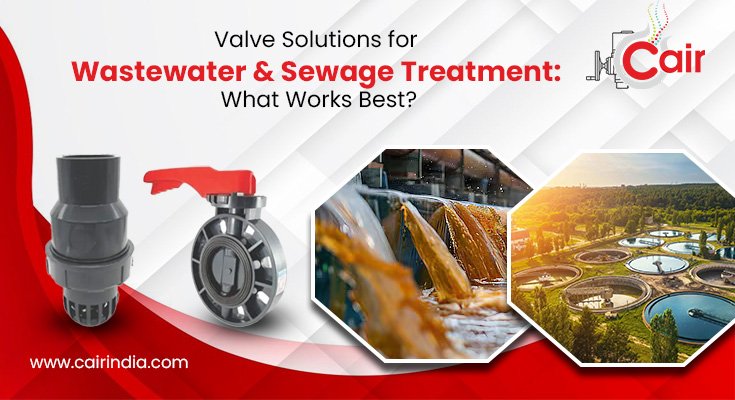
Let’s be honest – wastewater and sewage treatment is not the glamorous end of the water industry. Nobody puts it on their project brochure cover. But the valves running inside these plants? They’re arguably the hardest-working, most abused components in any fluid system in India.
Raw sewage. Sludge. Aggressive chemicals. Fibrous solids. Gases like hydrogen sulphide. These are the realities your valves face every single day inside a sewage treatment plant (STP) or effluent treatment plant (ETP). And yet, a surprising number of procurement teams still apply the same valve specifications they’d use for a clean water system – and then wonder why they’re replacing valves every 18 months.
This guide is written for plant engineers, procurement managers, and project consultants who are serious about getting valve selection right the first time in wastewater and sewage treatment applications. We’ll go stage by stage through a typical STP/ETP, explain what Ωeach stage demands from its valves, and give you concrete recommendations – including where Cair Euromatic’s product range fits the bill perfectly.
Why Wastewater Applications Are Uniquely Demanding
Before diving into valve types, it’s worth pausing to understand why wastewater service is so punishing on valves.
Solid-laden media. Sewage isn’t water – it’s water mixed with fibrous material, grit, biological solids, and suspended particles. A valve with a small bore or internal cavities will clog. Guaranteed.
Corrosive chemistry. Hydrogen sulphide gas (H₂S) is generated naturally in sewage systems and is highly corrosive to metals, particularly copper alloys and some grades of stainless steel. pH swings are also common in industrial effluent.
Biofilm and fouling. Bacteria will colonize any internal surface they can reach. Valves with rough internal finishes or unnecessary crevices become a maintenance nightmare very quickly.
Frequent actuation. In automated STPs, valves on return sludge lines, aeration control, and scum removal may cycle dozens of times a day. Actuation durability is non-negotiable.
Outdoor installations. Much of India’s sewage infrastructure sits outdoors – exposed to UV radiation, monsoon humidity, and summer heat. Materials and coatings matter far more than in a controlled indoor environment.
Get any of these wrong, and you’ll be paying for it in unplanned downtime, emergency valve replacements, and frustrated plant operators.
Wastewater Treatment: A Stage-by-Stage Valve Guide
Stage 1: Influent Receiving & Preliminary Treatment (Screening & Grit Removal)
This is where raw sewage first enters the plant. The media is at its most challenging here – high solids content, floating debris, grit, and often industrial effluents mixed in.
What valves face here: Sewage with suspended solids up to 200–500 mg/L, fibrous material, and intermittent flow surges.
Best valve choices:
Gate Valves (Full Bore) – For main influent isolation, nothing beats a full-bore gate valve. When fully open, there’s zero obstruction to flow, meaning solids pass through freely without clogging. Cair Euromatic’s Manual Gate Valves and Motorized Gate Valves are built for exactly this kind of robust isolation duty.
Butterfly Valves (Wafer/Lug Type) – For larger diameter lines (DN200 and above), butterfly valves offer space efficiency and cost advantages. However, in this stage, ensure the disc is positioned so it doesn’t trap solids in the closed position. Cair’s Manual Butterfly Valves are available in ductile iron construction with EPDM seats suitable for sewage service.
Pro Tip: At this stage, avoid ball valves. The spherical cavity in a ball valve can trap fibrous material when cycling between open and closed, leading to seat damage and leakage.
Stage 2: Primary Treatment (Primary Sedimentation / Clarifiers)
Here, heavy solids settle to the bottom as primary sludge, while lighter material floats as scum. The key valve duties are sludge withdrawal, scum removal, and clarifier inlet/outlet control.
What valves face here: Primary sludge is thick, heavy, and highly abrasive. Scum contains fats, oils, and greases (FOG). This is arguably the most valve-punishing stage in any STP.
Best valve choices:
Piston Valves – For sludge withdrawal lines, piston valves are among the best options available. Their full-bore design prevents clogging, and they provide excellent shutoff even with abrasive sludge. Cair Euromatic’s Piston Valve is specifically engineered for tough slurry and sludge applications and deserves serious consideration for this duty.
Gate Valves – A proven workhorse for sludge lines when full bore isolation is required and operation frequency is low.
Motorized Gate Valves – For automated sludge blanket control or timed sludge withdrawal, Motorized Gate Valves with electric actuators allow programmable, remote sludge removal without manual intervention – a major operational advantage for plants with limited operator staffing.
Globe Control Valves – For modulating scum removal rates and clarifier inlet flow balancing. Cair’s Motorized Globe Control Valve with a Valve Positioner is an excellent fit for applications requiring continuous flow modulation rather than simple open/close operation.
Stage 3: Secondary Treatment (Biological Stage – ASP / SBR / MBR)
This is the biological heart of the STP. Activated Sludge Processes (ASP), Sequential Batch Reactors (SBR), and Membrane Bioreactors (MBR) all operate here. Aeration is the dominant energy consumer, and valves control airflow, recirculated sludge, mixed liquor transfer, and effluent decanting.
What valves face here: Mixed liquor suspended solids (MLSS) up to 3,000–12,000 mg/L in MBR systems. Aeration air – wet, pressurized. Return Activated Sludge (RAS) and Waste Activated Sludge (WAS) – biological, odorous, thick.
Best valve choices:
Motorized Butterfly Valves – The go-to choice for aeration air control, mixed liquor transfer, and decanting in SBR systems. Fast actuation, reliable cycling, and available in large diameters for high-volume air and sludge lines. Cair Euromatic’s Motorized Butterfly Valves paired with Quarter Turn Electric Actuators are widely used in automated biological treatment systems across India.
Motorized Ball Valves – For smaller bore aeration distribution lines and instrument isolation, Motorized Ball Valves provide fast, reliable shutoff with bubble-tight closure.
Damper Valves – For aeration air distribution across diffuser headers, Motorized Damper Valves allow precise airflow balancing between multiple zones – critical for energy-efficient aeration control. Cair’s Manual Damper Valves are also available where manual setting is sufficient.
Key Automation Consideration: Modern STPs using SCADA-based aeration control require valves with position feedback. Cair’s Limit Switch Boxes provide open/closed position indication that feeds directly into your PLC or SCADA system.
Stage 4: Secondary Clarification & Sludge Recirculation
After biological treatment, mixed liquor goes to secondary clarifiers where biological sludge settles. Return Activated Sludge (RAS) is pumped back to the aeration tank; Waste Activated Sludge (WAS) goes to sludge treatment.
What valves face here: Biological sludge – lighter than primary sludge but still thick, viscous, and prone to settling in low-velocity pipe sections.
Best valve choices:
Gate Valves / Motorized Gate Valves – For RAS and WAS isolation. Full-bore design prevents sludge from bridging across a partially open valve disc.
Globe Control Valves – For RAS flow rate control. The ability to modulate flow precisely helps maintain the correct Sludge Volume Index (SVI) and mixed liquor concentration in the aeration tank. Cair’s Motorized Globe Control Valve with 4–20mA modulating actuator input is ideal here.
Piston Valves – Again, excellent for WAS withdrawal lines where sludge concentration is high and flow reliability is critical.
Stage 5: Tertiary Treatment & Disinfection
Depending on discharge standards (CPCB/SPCB norms), tertiary treatment may include sand filtration, UV disinfection, or chlorination. This stage handles relatively cleaner effluent – but disinfection chemicals make material selection critical.
What valves face here: Chlorine solution, sodium hypochlorite, UV-treated effluent. Mildly corrosive but aggressive toward carbon steel and certain elastomers.
Best valve choices:
UPVC Valves – For chlorine dosing lines and hypochlorite injection points, UPVC body construction is the right call. No corrosion, no contamination, cost-effective. Cair Euromatic’s UPVC Valve range is designed for exactly this kind of chemical-resistant service.
Diaphragm Valves – Where zero metal-to-fluid contact is required, diaphragm valves are the gold standard. The elastomer diaphragm acts as the sole contact surface with the process fluid, making them perfect for chemical dosing lines where purity and chemical resistance are paramount. Cair’s Motorized Diaphragm Valve is a strong option here.
Ball Valves (SS316) – For treated effluent isolation at filter inlets and outlets, stainless steel ball valves offer durability and corrosion resistance. Cair’s Manual Ball Valves are available in multiple material configurations to suit your specific requirement.
Stage 6: Sludge Thickening, Digestion & Dewatering
The sludge management train is often the most neglected part of STP design – and the most maintenance-intensive. Gravity thickeners, anaerobic digesters, belt filter presses, and centrifuges all rely on valves for sludge feed, recirculate, and gas management.
What valves face here: Thickened sludge (4–8% DS), digester gas (biogas – methane + CO₂ + H₂S), digester heating water, filtrate return. This is the most chemically and mechanically diverse valve environment in any STP.
Best valve choices:
Piston Valves – For thickened and digested sludge lines. Their full-bore, smooth-flow design handles high-solids sludge without plugging.
Gate Valves – For digester inlet/outlet isolation and sludge cake conveyance isolation.
Explosion Proof Electric Actuators – This is critical and often overlooked. Anaerobic digesters produce biogas (methane) – a flammable, explosive gas. Any electrical equipment in or near the digester area – including valve actuators – must be rated for hazardous area (ATEX/IECEx or IS/IEC 60079) use. Cair Euromatic’s Explosion Proof Electric Actuators are specifically designed and certified for use in these hazardous zone environments.
Ball Valves – For biogas piping (smaller diameter), full-bore ball valves with appropriate body materials prevent gas leakage at shutoff points.
The Automation Case: Why Smart Valves Matter in Modern STPs
India’s new STPs under AMRUT 2.0 and NMCG (National Mission for Clean Ganga) programmes are increasingly being built as automated plants – with SCADA control, remote monitoring, and minimal manual intervention. This changes the valve selection calculus significantly.
For any automated STP, here’s what Cair Euromatic recommends:
Electric Actuators over Pneumatic – In Indian STP environments, compressed air supply is often unreliable or absent. Electric actuators eliminate this dependency entirely. Cair’s full range of Electric Actuators – from Quarter Turn to Multi Turn to Linear – provides the right actuation for every valve type in your plant.
Valve Positioners for Modulating Control – Anywhere you need precise flow regulation (RAS control, chemical dosing, aeration balancing), a Valve Positioner converts your 4–20mA control signal into accurate valve position, enabling true proportional control from your PLC.
Limit Switch Boxes for Position Feedback – Every motorized valve in an automated STP should have open/close position feedback to the SCADA system. Cair’s Limit Switch Boxes are compatible with their full valve and actuator range and provide reliable position indication.
Manual Override – Even in automated plants, operators need the ability to manually position a valve during maintenance or power failure. Cair’s Manual Override accessories ensure your automated valves can always be operated safely during emergencies.
Gear Boxes for Large Valves – For large-diameter butterfly or gate valves in main sludge lines, manual operation without a gearbox is physically impractical. Cair’s Gear Box accessories reduce operating torque to manageable levels for large valve sizes.
Quick Reference: Valve Selection Summary for Wastewater Plants
| STP Stage | Application | Recommended Valve | Actuation |
| Influent receiving | Main inlet isolation | Gate Valve (full bore) | Manual / Motorized |
| Preliminary | Large diameter isolation | Butterfly Valve | Manual / Motorized |
| Primary clarifier | Sludge withdrawal | Piston Valve / Gate Valve | Manual |
| Primary clarifier | Scum removal, flow control | Globe Control Valve | Motorized + Positioner |
| Biological (ASP/SBR) | Aeration air control | Butterfly / Damper Valve | Motorized |
| Biological (MBR) | Mixed liquor transfer | Motorized Butterfly Valve | Electric Actuator |
| Secondary clarifier | RAS/WAS flow control | Globe Control / Gate Valve | Motorized |
| Tertiary / Disinfection | Chemical dosing | UPVC Valve / Diaphragm Valve | Manual / Motorized |
| Sludge digestion (biogas) | Hazardous area service | Gate / Ball Valve | Explosion Proof Actuator |
| Dewatering | Thickened sludge | Piston Valve | Manual |
5 Common Mistakes to Avoid in Wastewater Valve Procurement
- Using reduced-bore valves on sludge lines. Reduced bore means reduced flow area means blocked valve. Always specify full-bore valves for any sludge or slurry service.
- Ignoring H₂S corrosion in material selection. Hydrogen sulphide attacks copper alloys and certain bronze grades aggressively. Specify ductile iron bodies with epoxy lining, UPVC, or SS316 for any application near sewage or digester areas.
- Fitting standard actuators in hazardous areas. This is a safety violation, not just a technical mistake. Any electrical equipment near anaerobic digesters or enclosed sewage lift stations must be explosion-rated. Cair’s Explosion Proof Electric Actuators meet this requirement.
- No provision for manual override. During power cuts or PLC failures, automated valves become useless – and potentially dangerous – without a manual override option. Always specify manual override on motorized valves in critical service.
- Choosing suppliers without after-sales support. A valve that fails at 2 AM during a monsoon storm needs a supplier who answers the phone. Cair Euromatic’s pan-India service network and local spare availability has kept Indian STPs and ETPs running when imported brands couldn’t deliver.
Why Cair Euromatic Is the Right Partner for Wastewater Projects
Cair Euromatic Automation Pvt. Ltd. has been manufacturing valves and electric actuators in India for over 30 years. Their Ahmedabad facility produces the complete spectrum of products that a wastewater treatment plant needs – from basic manual isolation valves to sophisticated explosion-proof motorized valve assemblies.
For wastewater and sewage projects specifically:
- Their complete product range – Manual Valves, Motorized Valves, and Electric Actuators – can serve every stage of your STP from a single source
- All products come with proper certifications and approvals – critical for government projects and regulatory compliance
- Their accessories ecosystem (positioners, limit switch boxes, gear boxes, manual overrides) means you can build a fully integrated automated valve system without juggling multiple vendors
- You can view their full product catalogue here or reach their team directly through the inquiry page
Final Thoughts
Wastewater treatment doesn’t get the attention it deserves – but the valves running inside an STP work harder than almost anything else in the water sector. They handle the worst media, the most aggressive chemicals, and the most demanding duty cycles.
Getting the valve selection right means understanding each stage of the treatment process, matching the valve design and material to the actual service conditions, building in the right level of automation, and partnering with a manufacturer who truly understands this application – not just one who sells valves.
If your current valve specifications for wastewater projects are a copy-paste from a water supply plant, it’s time to revisit them.
Have a wastewater or sewage treatment project in progress? Talk to Cair Euromatic’s application engineers for stage-by-stage valve recommendations tailored to your plant design.
inquiry@cairindia.com +91 79 2970 8286 | +91 756 786 2575
Contact Us | Submit an Inquiry | Download Catalogue