
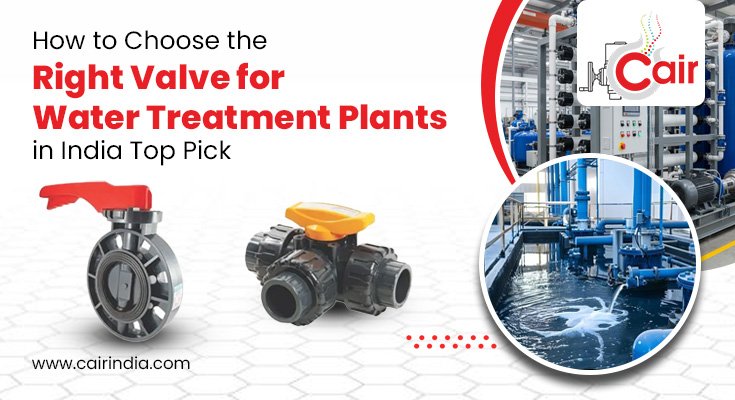
If you’re part of a water treatment procurement team in India, you already know the pressure that comes with the job – literally and figuratively. Selecting the wrong valve for the wrong application can mean leaks, process failures, regulatory non-compliance, or sky-high maintenance costs. And yet, a lot of buyer guides out there either go too deep into theory or are written for audiences in the West, with little relevance to Indian water infrastructure challenges.
This guide is written specifically for procurement engineers, plant managers, and project consultants working on water treatment plants (WTP) and sewage treatment plants (STP) across India. We’ll walk you through what valves are used in water treatment, how to choose between them, what questions to ask your supplier, and which products from Cair Euromatic are worth serious consideration.
Let’s get into it.
Why Valve Selection Matters More Than Most People Think
Water treatment is not a forgiving industry. Valves here are not just on-off devices – they are gatekeepers of flow rate, pressure, chemical dosing accuracy, backwash cycles, sludge management, and ultimately, the quality of water reaching millions of people.
India’s water treatment sector is growing rapidly. Under schemes like AMRUT (Atal Mission for Rejuvenation and Urban Transformation) and Jal Jeevan Mission, hundreds of new WTPs and STPs are being built or upgraded across the country. Procurement teams are under pressure to deliver on tight budgets while meeting BIS standards and ensuring long operational lifespans.
A bad valve choice at the design stage can cost your project 10x in maintenance down the line. So let’s make sure you choose right the first time.
Stage-by-Stage Breakdown: Which Valve Goes Where?
Before choosing a valve type, you need to understand where in the water treatment process it will be deployed. Different stages have very different requirements.
1. Raw Water Intake & Screening
At this stage, water enters from a river, reservoir, or borewell. Flow volumes are high, pressures are moderate, and the water carries suspended solids, debris, and sometimes sand.
Recommended Valves:
- Gate Valves – Ideal for isolation duty in large-diameter pipelines. They offer minimal flow resistance when fully open and are robust enough for raw water with suspended solids. Explore Cair’s Manual Gate Valves and Motorized Gate Valves for automated intake control.
- Butterfly Valves – For large-bore lines (DN200 and above), butterfly valves are cost-effective and space-saving. Cair offers a comprehensive range of Manual Butterfly Valves and Motorized Butterfly Valves suitable for this duty.
Key Selection Criteria Here: Bi-directional sealing, corrosion-resistant body material (ductile iron or CI), and full port design for minimal pressure drop.
2. Coagulation & Flocculation
Chemical dosing happens here – alum, lime, polyelectrolytes. The fluid is mildly corrosive and often carries fine particles in suspension.
Recommended Valves:
- Ball Valves – For chemical dosing lines, ball valves offer tight shutoff, quick operation, and excellent chemical resistance when using PTFE seats. Cair’s Manual Ball Valves are a reliable choice for small-bore dosing lines.
- Diaphragm Valves – Where strict hygiene and zero contamination matter, diaphragm valves are unbeatable. They have no internal cavities where sediment can collect. Check out Cair’s Motorized Diaphragm Valve range for automated dosing control.
- UPVC Valves – For aggressive chemical environments, UPVC-bodied valves resist corrosion and are cost-effective. Cair offers UPVC Valves specifically designed for chemical service.
3. Sedimentation & Clarification
Water moves slowly here. Valves control inlet/outlet flow and sludge withdrawal lines. The major challenge is sludge – thick, sticky, abrasive in nature.
Recommended Valves:
- Gate Valves (for sludge lines) – Full bore opening prevents clogging.
- Piston Valves – Excellent for sludge and slurry service where media has suspended solids. Cair’s Piston Valve is engineered for exactly this kind of tough-duty application.
- Globe Valves – For throttling and flow regulation in clarifier outlet lines. Cair offers both Manual Globe Valves and Motorized Globe Control Valves for modulating service.
4. Filtration (Sand Filters / Rapid Gravity Filters)
This is one of the most valve-intensive stages. Multiple valves operate in sequence for filtration, backwash, and rinse cycles. Automation is highly desirable here.
Recommended Valves:
- Motorized Butterfly Valves – For filter inlet, outlet, backwash inlet, and drain duties. Automated operation enables programmable filter backwash cycles. Cair’s Motorized Butterfly Valves with electric actuators are purpose-built for this kind of sequential multi-valve operation.
- Motorized Ball Valves – For smaller bore applications within filtration systems, Cair’s Motorized Ball Valves deliver fast actuation and bubble-tight shutoff.
Pro Tip: For backwash automation, pair your valves with Cair’s Quarter Turn Electric Actuators and Limit Switch Boxes to build a fully automated, remotely monitorable backwash cycle.
5. Disinfection (Chlorination / UV / Ozone)
Chlorine is aggressive. Chlorinated water attacks metals and elastomers. Material selection is critical.
Recommended Valves:
- UPVC Ball Valves – For chlorine dosing and distribution lines, UPVC construction withstands chemical attack. Cair’s UPVC Valve range is designed for chemical-resistant service.
- Diaphragm Valves – No metal contact with the process fluid; hygienic and corrosion-resistant.
6. Treated Water Storage & Distribution
From clear water reservoirs into the distribution network. High flow rates, varying pressures, and the need for reliable isolation.
Recommended Valves:
- Butterfly Valves – For large-diameter distribution mains. Cost-effective, easy to actuate.
- Gate Valves – For isolation points along distribution networks.
- Motorized Gate Valves – For remote-operated isolation in unmanned pump houses. See Cair’s Motorized Gate Valve range.
- Globe Control Valves – For pressure regulation and flow throttling in delivery headers.
The 7-Point Valve Selection Checklist for Indian WTP Procurement
Here’s a practical checklist your team can use during vendor evaluation and procurement:
- Media Compatibility What fluid will the valve handle – raw water, treated water, sludge, chlorine solution, coagulant? Match body material, seat material, and seal material accordingly. Don’t assume “it’s just water.”
- Pressure & Temperature Rating Confirm the operating pressure and temperature. For Indian climate extremes – from Rajasthan summers to Northeast monsoons – thermal expansion matters more than most engineers admit.
- End Connection & Size IS (Indian Standard) flanges are standard in Indian water infrastructure. Confirm flange drilling pattern (IS:1538 / BS:4504 / ANSI) and pipe schedule compatibility before ordering.
- Actuation Requirement Will the valve be operated manually, by electric actuator, or by pneumatic actuator? If your plant is moving toward SCADA-based automation (which most new Indian WTPs are), electric actuators are the right call. Cair’s Electric Actuator range covers Quarter Turn, Multi Turn, Linear, and even Explosion Proof variants.
- Duty Type Is this valve for isolation (open/close only), throttling (flow regulation), or modulating (continuous position control)? A gate valve that someone tries to use for throttling will wear out in months. Use the right valve for the right duty.
- Frequency of Operation Valves on backwash cycles may operate 4–6 times per day. Valves on isolation duty may operate once a month. Life expectancy and actuator sizing depend heavily on this.
- After-Sales Support & Spare Parts Availability In Indian WTP projects, this is where many imported valve brands fall flat. When you need a replacement actuator or seal kit in Nagpur or Bhopal, local support matters. Cair Euromatic, based in Ahmedabad with pan-India distribution, offers reliable service support and ready spare availability.
Manual vs. Motorized Valves: What’s Right for Your Plant?
This is a question almost every procurement team faces. Here’s a simple way to think about it:
Choose Manual Valves when:
- The valve is operated infrequently (less than once per week)
- The valve location is easily accessible to operators
- Budget is tight and no automation infrastructure exists
- Small bore applications (DN15–DN50) in utility service
Choose Motorized Valves when:
- The valve is operated frequently or on a programmable schedule
- The valve is in a remote, unmanned, or confined-space location
- Your plant uses SCADA, PLC, or BMS control systems
- You need position feedback (open/close indication) for monitoring
- Safety interlocks require automatic closure on fault conditions
Cair Euromatic offers the full spectrum – from simple Manual Ball Valves to sophisticated Motorized Globe Control Valves with 4–20mA positioner feedback. This means your entire plant – from raw water intake to treated water delivery – can be sourced from a single trusted manufacturer.
Material Guide: What Body Material Should You Specify?
| Application | Recommended Body Material |
| Raw water intake | Cast Iron (CI) or Ductile Iron (DI) |
| Chemical dosing lines | UPVC, SS316, or lined CI |
| Treated water mains | Ductile Iron with epoxy lining |
| Sludge / slurry | Ductile Iron, full bore gate or piston |
| Chlorine service | UPVC, Hastelloy, or SS316 |
| Seawater / brackish water | SS316 or Super Duplex |
Red Flags to Watch for When Choosing a Valve Supplier
Having spent decades in this industry, Cair Euromatic has seen procurement teams get burned by a few recurring pitfalls. Watch out for:
Suppliers who can’t share test certificates – Any credible valve manufacturer should be able to share hydrostatic test, seat leakage test, and material test certificates. Cair Euromatic maintains all certificates and approvals for full traceability.
Valves with no local service network – If your supplier is only reachable over email, you’ll be in trouble during a plant shutdown. Always ask about local support.
Mixing valve and actuator brands carelessly – Actuator-to-valve interface compatibility (ISO 5211 mounting flange) matters. When you source both from a single manufacturer like Cair Euromatic, this integration is already engineered and tested.
Low-grade elastomers in tropical climates – EPDM and NBR grades vary widely. Cheap rubber seals degrade fast under UV exposure and temperature cycling in Indian outdoor installations.
Why Water Treatment Plants Across India Trust Cair Euromatic
Cair Euromatic Automation Pvt. Ltd. has over 30 years of experience in valve and actuator manufacturing from their facility in Ahmedabad, Gujarat. Their products serve the water supply industry, wastewater & sewage sector, and many other industries across India.
What sets them apart for WTP projects:
- Complete product range – from manual isolation valves to fully automated motorized valve assemblies with electric actuators
- Application engineering support – their team helps you match the right valve to your specific process stage
- Certified products – all major approvals and quality certifications are in place, viewable on the certificates page
- Strong after-sales network – local support and service across India
- Accessories ecosystem – Valve Positioners, Limit Switch Boxes, Gear Boxes, and Manual Overrides available as part of a complete solution
You can download their full product catalogue here or submit a project-specific inquiry here.
Final Word
Choosing the right valve for a water treatment plant isn’t about picking the cheapest option or blindly following a spec sheet from another project. It’s about understanding the specific demands of each process stage, matching that to the right valve type and material, deciding on the right actuation strategy, and choosing a supplier who can support you after the purchase order is signed.
India’s water infrastructure is being built and rebuilt at a scale not seen before. The decisions procurement teams make today will define how reliably millions of people receive clean water for the next two decades.
Choose your valves carefully. Choose your supplier wisely.
Ready to discuss your project? Contact Cair Euromatic at inquiry@cairindia.com or call +91 79 2970 8286. You can also visit the full product range or submit an inquiry online.