
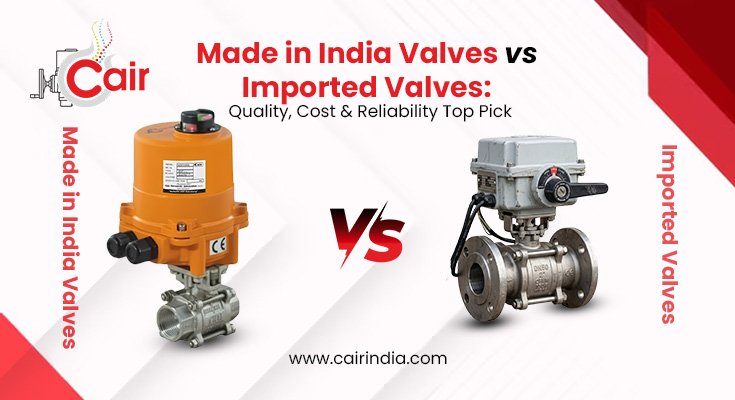
There is a question that comes up in procurement meetings, on plant floors, and across tender evaluation committees across India – and it is a question that nobody seems to want to answer directly: Are Indian-made valves actually as good as imported ones?
For decades, there has been a quiet assumption in parts of Indian industry that imported means better. European valves carried a premium – and paid for it with a reputation for precision engineering. Chinese valves flooded the market at prices that seemed impossible to match – and came with their own set of stories about failures and disappointments.
Meanwhile, India’s own valve manufacturing industry has grown up considerably. It has invested in modern machining, international certifications, and engineering capability. The Make in India initiative, Aatmanirbhar Bharat, and the government’s Production Linked Incentive (PLI) scheme have accelerated this transformation. Yet the old assumptions persist.
This guide is here to replace assumptions with facts. We will walk through an honest, data-backed comparison of Made in India valves against imported alternatives – on quality, cost, lead time, compliance, after-sales support, and total cost of ownership. And we will show you exactly where Cair Euromatic fits into that picture.
India’s Valve Industry Today: A Market Transformed
India’s industrial valve market is not a cottage industry anymore. It is one of the fastest-growing valve markets in the world.
Market fact: India’s industrial valve market reached USD 3.4 billion in 2025 and is projected to grow to USD 6.3 billion by 2034 at a CAGR of 6.64%, driven by oil & gas, water infrastructure, chemical, and pharmaceutical sector expansion.
Indian manufacturers lead demand across water treatment, pharmaceuticals, chemical processing, and power generation – all sectors where product failure is not just a maintenance issue, it is a safety and compliance issue. That pressure has driven Indian manufacturers to raise their game significantly over the past decade.
At the same time, the market still has an import challenge. India imports approximately 40–45% of its industrial valve requirements, primarily from China, Germany, and the United States. While European imports fill genuine high-specification niches, low-cost Chinese imports – many without proper quality documentation – have created problems for plant operators who chose them purely on purchase price.
Industry concern: The influx of low-cost imported valves has raised serious concerns about quality and durability, including risks from counterfeit products entering the Indian market through grey channels. Counterfeit valves of inferior quality pose direct risks to industrial operations and safety.
Quality: Where Indian Manufacturers Now Stand
This is where the conversation gets interesting – because ‘imported’ covers an enormous range. A German KSB valve and a no-name Chinese valve from an unknown factory are both ‘imported’. Treating them as equivalent is as misleading as treating a Tata valve and a backyard casting shop as equivalent ‘Made in India’.
The honest quality comparison should be made on specifics, not geography. Here is what matters:
Material Traceability and Certification
Reputable Indian manufacturers like Cair Euromatic provide full material test certificates (MTCs) for all product-contact components – the same documentation required for pharmaceutical, food, and government water infrastructure projects. Low-cost Chinese imports frequently arrive without this documentation, or with certificates that cannot be independently verified. For regulated industries, this is a disqualifying problem.
Dimensional and Pressure Testing
Indian valve manufacturers certified to ISO 9001, BIS standards, and international test protocols (ISO 5208 for pressure testing, API 598 for valve inspection) are producing valves to the same dimensional and performance standards as European manufacturers. The Bureau of Indian Standards’ IS 14846 specification for sluice valves – mandatory for government waterworks procurement – is a rigorous standard. Indian manufacturers meeting it are producing quality that can withstand government inspection.
Certifications Held by Leading Indian Manufacturers
Cair Euromatic holds certifications including CE marking, ATEX (for explosion-proof actuators), IECEx, PESO, TÜV Nord, and ISI mark – the same certifications required for export to European and international markets. These are not rubber-stamp certifications; they require third-party audits of manufacturing facilities, processes, and products.
Cair Euromatic certifications: CE Mark | ATEX | IECEx | PESO | TÜV Nord | ISI | EX Mark – covering exports to Europe, Middle East, and compliance with Indian statutory requirements.
Where European Imports Still Have an Edge
To be honest: in a narrow set of truly demanding applications – ultra-high-pressure subsea valves above 500 bar, extreme cryogenic service at temperatures below −150°C, or exotic alloys like Hastelloy C-276 for concentrated acid service – European and American manufacturers with decades of application-specific engineering still lead. These are niche applications. For the vast majority of industrial applications in India – including water treatment, pharmaceuticals, food processing, chemicals, HVAC, and general manufacturing – Indian-made valves deliver equivalent performance.
Cost: The Full Picture Beyond Purchase Price
Purchase price is only one number. The real cost of a valve is its Total Cost of Ownership (TCO) – purchase price, plus import duties, plus freight and lead time cost, plus maintenance cost, plus replacement frequency, plus after-sales support.
Here is where the Made in India valve consistently wins when you do the full calculation:
Import Duties and Customs
Imported valves into India attract basic customs duty typically ranging from 7.5% to 15% depending on the HS code, plus GST. Chinese valves additionally face anti-dumping duties on specific categories. Add freight insurance and customs clearance costs, and that ‘cheap’ imported valve has gained 20–30% in landed cost before it reaches your store.
Lead Time as a Cost
A valve sitting in a factory in Zhejiang, China, takes 4–16 weeks to reach an Indian plant via sea freight. During a plant shutdown waiting for a replacement valve, the cost of lost production often dwarfs the cost of the valve itself. An Indian manufacturer can ship from Ahmedabad to anywhere in India in 7–21 days. For urgent maintenance requirements, that difference is enormous.
TCO illustration: See the worked example below for a DN50 stainless steel ball valve comparing a Made in India valve against a low-cost Chinese import over a 3-year period. The numbers are indicative but based on real-world cost patterns.
| Cost Item | Made in India Valve | Low-cost Chinese Import |
| Purchase price (DN50 ball valve) | ₹4,200 | ₹2,800 |
| Freight / import duties | ₹0 | ₹420 (15% avg duty) |
| Lead time cost (production downtime) | ₹0 | ₹8,000+ (3-week wait) |
| Replacement at 18 months (failure) | Unlikely | ₹2,800 (avg failure rate) |
| After-sales support cost | ₹0 (direct warranty) | ₹600 (distributor charges) |
| Total 3-year Cost | ₹4,200 | ₹14,620+ |
The TCO gap widens further when you factor in engineering time spent dealing with documentation issues, customs delays, and warranty disputes with overseas suppliers through Indian distributors – all real costs that rarely appear in a purchase order.
Reliability: The Metrics That Actually Matter
Reliability in industrial valve applications is measured in three ways: Mean Time Between Failures (MTBF), leak performance over time, and actuator cycle life. The perception that imported valves are more reliable is rarely supported by documented plant records when you compare equivalent specification products from certified Indian manufacturers against equivalent imports.
What drives reliability is not the country of origin – it is the manufacturing process, material quality, and quality control discipline of the specific manufacturer. A certified Indian valve manufacturer with documented machining tolerances, material testing, and final inspection protocols produces a more reliable valve than an uncertified import from an unknown factory – regardless of which country that factory is in.
The Counterfeit Import Problem
India’s industrial valve market has a genuine counterfeit problem on the import side. Valves are sold with forged BIS marks, fake material certificates, and brand names that imitate established European manufacturers. This is not a theoretical risk – it results in real plant failures.
Industry warning: Counterfeit valves entering India under false certifications pose serious industrial safety risks. Indian manufacturers operating under direct BIS oversight and third-party certification audits are substantially lower risk on this dimension.
After-Sales Support: Where Indian Manufacturers Win Clearly
When a valve fails at 11 PM during a production run, you need an engineer – not an email to a distributor who will forward it to an overseas supplier. This is the most underappreciated advantage of buying from an Indian manufacturer.
Cair Euromatic has a direct technical team in Ahmedabad available for application support, troubleshooting, and warranty handling. Spare parts are in stock. Replacement valves can be dispatched within days. There is no distributor chain between the manufacturer and the customer.
Compare this to the typical experience with imported valves: the Indian distributor has limited technical knowledge, the overseas manufacturer responds on a different time zone, and spare parts either don’t exist or take weeks to arrive.
Compliance and Documentation: The Government Procurement Reality
For Indian government projects – Jal Jeevan Mission, AMRUT 2.0, state water authority tenders, defence and PSU procurement – compliance with Indian standards is mandatory. BIS IS 14846 for sluice valves, IS 5312 for check valves, and various sector-specific standards are pre-qualification requirements.
Procuring BIS-certified valves from an Indian manufacturer is straightforward: the manufacturer provides the BIS licence number, the certification documentation, and material test certificates directly. There is no third-party testing cost, no import verification process, and no ambiguity about whether the certified product matches what was shipped.
Procuring imported valves for BIS-required applications requires either finding an importer who has obtained a BIS licence for that product in India (rare and expensive for most valve categories) or going through third-party testing – adding cost, time, and uncertainty to every tender.
Procurement note: Standards compliance to BIS IS 14846 and other Indian standards directly influences tender evaluation outcomes across government water, power, and infrastructure projects. Indian manufacturers with direct BIS certification have a structural advantage in this procurement environment.
Make in India and Aatmanirbhar Bharat: The Bigger Picture
The Make in India initiative launched in 2014 and the subsequent Aatmanirbhar Bharat (Self-Reliant India) push have fundamentally changed the environment for Indian industrial manufacturers. The Production Linked Incentive (PLI) scheme, which covers 14 key sectors with a total outlay of ₹1.97 lakh crore, has directed investment into domestic manufacturing capability at a scale that was not previously possible.
PLI impact (March 2025): Total production under PLI schemes has exceeded ₹7.5 lakh crore, with actual investments reaching ₹1.76 lakh crore. Manufacturing FDI rose 18% year-on-year in FY 2024-25 to USD 19.04 billion, signalling strong global confidence in Indian manufacturing quality.
For the valve industry specifically, this has meant investment in CNC machining precision, metallurgical testing capability, international certification infrastructure, and engineering talent. The results are visible in the quality of products coming from leading Indian valve manufacturers today compared to a decade ago.
Beyond economics, there is a supply chain resilience argument that Indian procurement teams are increasingly making. The COVID-19 pandemic and post-pandemic logistics disruptions taught industries worldwide – and Indian plant managers specifically – what happens when critical components are dependent on long international supply chains. A valve ordered from Ahmedabad has none of that supply chain risk.
The Environmental and Social Case
Buying from Indian manufacturers reduces carbon emissions from international freight. It supports Indian employment and industrial skill development. It keeps value within the Indian economy. For organisations with ESG (Environmental, Social, Governance) commitments, domestic procurement increasingly counts toward measurable sustainability targets.
Made in India vs Imported: Head-to-Head Comparison
Here is the full comparison across every factor that matters to an industrial procurement decision:
| Factor | Made in India Valve | Imported Valve (China/Europe) |
| Lead time | 7–21 days (domestic stock) | 4–16 weeks (sea freight) |
| After-sales support | Local engineers, same-day response | Distributor-dependent, slow |
| Customisation | Available – MOQ flexible | High MOQ, slow turnaround |
| Spare parts availability | Immediate from manufacturer/stock | Often unavailable or costly |
| Compliance (BIS, IS 14846) | Direct from source, easy documentation | Requires third-party testing |
| Accountability | Manufacturer takes direct responsibility | Importer intermediary |
| Price (low-end Chinese) | Higher upfront (5–30%) | Lower upfront, higher TCO |
| Price (European) | 20–60% lower | Premium pricing |
| Warranty support | Direct – manufacturer handles it | Via distributor, often slow |
| Counterfeit risk | Low – verified supply chain | High for Chinese grey market |
When to Choose Made in India vs. When to Consider Importing
To be balanced: there are situations where importing genuinely makes sense. Here is an honest framework:
| Your Situation | Best Choice | Why |
| Urgent replacement needed within days | Made in India | Stock available, ships same week |
| Government tender (IS / BIS required) | Made in India | Direct compliance documentation |
| Budget is critical, one-off small order | Consider carefully | Weigh upfront vs. TCO + risk |
| Highly specialised alloy or cryogenic | European import | For truly niche technical specs |
| Pharma / food GMP-regulated plant | Made in India | Documentation and audit support |
| Long-term MRO / annual rate contract | Made in India | Consistent supply, no lead time surprises |
| Remote site, minimal maintenance resources | Made in India | Local support without logistics delays |
The important thing is to make this decision on facts – not on assumptions about country of origin. The question to ask is not ‘Is this imported?’ or ‘Is this Indian-made?’ The question is: ‘Is this manufactured by a certified, accountable manufacturer who can support me throughout the product’s life?’ For most industrial applications in India, that answer increasingly points domestic.
Why Cair Euromatic Is the Made in India Valve Choice
Cair Euromatic has been manufacturing valves and electric actuators in Ahmedabad, Gujarat, for over 20 years. Their products are used across water treatment plants, pharmaceutical manufacturing facilities, chemical processing plants, food and beverage production, oil and gas installations, and power generation units across India.
What makes Cair Euromatic the right Made in India choice for procurement teams across these sectors:
- Certified to CE, ATEX, IECEx, PESO, TÜV Nord, ISI – same certifications required for European export and Indian statutory compliance
- Direct manufacturer relationship – no distributor chain between you and engineering support
- Full material traceability – material test certificates available for all product-contact components
- Customisation capability – non-standard sizes, materials, actuator configurations available at realistic lead times and without European MOQ minimums
- Proven range covering the full valve automation spectrum – from UPVC chemical dosing valves to explosion-proof actuated ball valves for hazardous area service
- 20+ years serving the Indian industrial market – documented track record, not a new entrant
The full product range includes:
→ All Motorized Valves – Butterfly, ball, globe, gate, diaphragm, pinch, damper
→ All Manual Valves – SS and UPVC ball, butterfly, gate, globe, piston
→ Electric Actuators – Quarter-turn, multi-turn, explosion-proof, linear
→ UPVC Valve Range – For chemical, water treatment, and corrosive service
→ Motorized Ball Valves – 10 product variants for every application
→ Accessories – Positioners, limit switch boxes, manual overrides
Get in touch:
+91 79 2970 8286 | +91 756 786 2575
Summary: The Honest Verdict
Made in India valves from certified manufacturers are now fully competitive with imported alternatives across the vast majority of industrial applications – on quality, certification, reliability, and especially on total cost of ownership when you factor in lead time, after-sales support, and compliance documentation.
The situations where importing makes genuine sense are narrow: truly niche high-specification applications requiring exotic materials or extreme performance parameters that Indian manufacturing has not yet addressed. For everything else – water treatment, pharmaceuticals, food processing, chemicals, HVAC, general manufacturing – a certified Indian manufacturer is the right choice.
And the broader argument for Made in India goes beyond individual procurement decisions: it builds supply chain resilience, supports domestic industry and employment, and reduces India’s industrial import dependency – which currently stands at 40–45% of valve requirements.
That is an import bill that Indian manufacturers like Cair Euromatic are working hard to bring home.
Frequently Asked Questions
For the majority of industrial applications – water treatment, chemicals, pharmaceuticals, HVAC, food processing, and general manufacturing – certified Indian valve manufacturers produce products that meet the same international standards as European manufacturers. For truly specialised extreme-service applications (ultra-high pressure, exotic alloys, sub-sea), European manufacturers retain a niche lead.
Chinese valves are cheaper for several reasons: lower labour costs, lower raw material costs, weaker regulatory compliance overhead, and – for grey-market products – the absence of certification costs that certified manufacturers must bear. The lower purchase price frequently comes with hidden costs: shorter service life, absent documentation, no warranty support, and counterfeit risk. The total cost over 3 years is often higher than a certified Indian valve.
Yes. Leading Indian valve manufacturers hold international certifications including ISO 9001, CE mark, ATEX, IECEx, API, and ASME. Cair Euromatic specifically holds CE, ATEX, IECEx, PESO, TÜV Nord, and ISI certifications – the same certifications required for European export.
Indian government projects under Jal Jeevan Mission, AMRUT 2.0, and state utility tenders frequently require BIS certification (IS 14846 for sluice valves, for example) as a pre-qualification criterion. Indian manufacturers with direct BIS licences provide this documentation straightforwardly; imported valves require expensive and time-consuming third-party Indian BIS testing.
TCO is the full cost of a valve over its service life, including: purchase price + import duties and freight + lead time cost (production downtime while waiting) + maintenance and spare parts + replacement frequency + after-sales support cost. When all these are included, certified Indian valves typically deliver lower TCO than low-cost Chinese imports and significantly lower TCO than European premium imports for standard applications.
Ask for: (1) current ISO 9001 certificate with expiry date;
(2) BIS licence number (verifiable on the BIS website);
(3) CE/ATEX/IECEx certificates with certificate number (all verifiable with the issuing body);
(4) material test certificates for the specific batch supplied. A genuine manufacturer will provide all of these without hesitation.