
Here’s a scenario that plays out on plant floors more often than you’d think: someone specifies an electric actuator for a large gate valve, everything gets installed, and then the actuator starts straining, overheating, or tripping on torque overload every time it tries to open or close. Nine times out of ten, the missing piece isn’t a bigger actuator – it’s a gearbox that should have been in the spec from the start.
Gearboxes don’t get nearly the attention that actuators or valves do, but for certain applications, they’re the difference between a system that works reliably for years and one that burns out its motor within months. Let’s get into what a gearbox actually does, when you genuinely need one, and when you can skip it.
What Does a Gearbox for a Valve Actuator Actually Do?
A gearbox sits between the actuator (electric, pneumatic, or manual handwheel) and the valve stem. Its job is simple in principle: multiply torque and reduce speed. An actuator’s motor produces a certain amount of rotational force at a certain speed – a gearbox trades some of that speed for a proportional increase in torque, using a set of meshing gears (commonly worm-and-wheel, bevel, or spur configurations).
In practice, this means a smaller, more affordable actuator can operate a valve that would otherwise require a far larger and more expensive unit to generate enough torque on its own. For large-diameter valves, high-pressure services, or valves that have simply become stiff with age or scaling, that torque multiplication is often non-negotiable.
For background on how actuators generate that initial torque before a gearbox comes into the picture, our guide to valve actuators and how they work is worth a read.
Worm Gear vs Bevel Gear: The Two Common Types
The two gearbox styles you’ll come across most often each solve a slightly different problem:
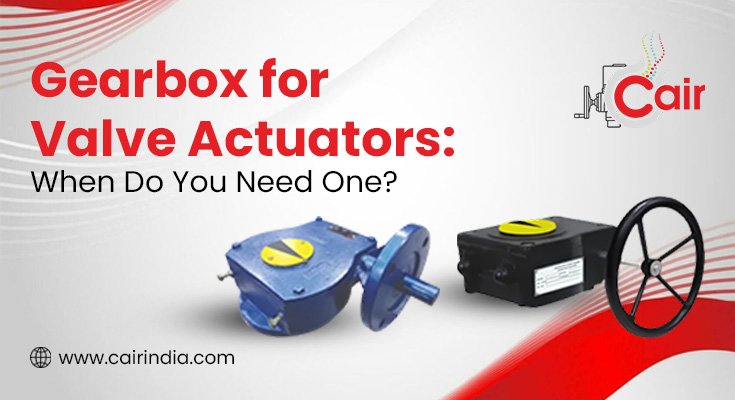
Worm gearboxes use a screw-like worm meshing with a toothed wheel. They offer very high reduction ratios and, importantly, are usually self-locking – the friction angle between the worm and the wheel makes it extremely difficult for the valve to “back-drive” under process pressure or vibration once the actuator stops. This is exactly why worm gearboxes are the default choice for quarter-turn valves like ball and butterfly valves, where holding position securely without drifting matters as much as opening and closing it in the first place.
Bevel gearboxes use intersecting-shaft gears set at an angle (typically 90°), which is useful less for extreme torque multiplication and more for changing the direction of the drive – for instance, converting a horizontal actuator’s output into vertical motion for a rising-stem gate or globe valve. Bevel gearboxes are common where multi-turn actuators need to be mounted at an angle relative to the valve stem due to space constraints.
We manufacture both configurations – you can see the technical range for our spare bevel gear box for electrical actuators, and our full gearbox accessory range covers worm-type units as well, sized from moderate to very high torque ratings.
When Do You Actually Need a Gearbox?
Not every actuator-valve pairing needs one. Here’s a practical checklist for when a gearbox earns its place in the spec:
- The valve is large or the required torque exceeds what a compact actuator can deliver directly. Big gate valves, large-diameter butterfly valves, and high-pressure globe valves often demand torque figures well beyond what a small, direct-drive actuator can produce without becoming oversized and expensive.
- The valve needs to hold position securely without drifting. In services where fluid pressure, vibration, or water hammer could otherwise nudge the valve open or closed over time, a self-locking worm gearbox keeps the valve exactly where it was left, without relying on the actuator’s braking alone.
- Space or mounting constraints require a change in drive direction. If the actuator can’t be mounted in line with the valve stem due to physical clearance, a bevel gearbox lets you redirect the drive at 90° without redesigning the piping layout.
- You’re retrofitting an existing manual valve for automation. Older manual valves, especially ones that have stiffened with age, scaling, or corrosion, often need substantially more torque than their original handwheel rating suggests. A gearbox lets you automate them with a reasonably sized actuator instead of oversizing the whole unit.
- The application involves frequent cycling or heavy-duty service. Repeated operation puts wear on an actuator’s internal gearing over time. A dedicated external gearbox, built for the mechanical load, spreads that wear across a component designed specifically for it, extending the actuator’s own service life.
When You Can Skip It
If you’re automating a small or medium ball valve, a lightweight damper, or any application where the required torque comfortably sits within a compact actuator’s direct output range, adding a gearbox is often unnecessary cost and complexity. Direct-mounted actuators are simpler, have fewer moving parts to maintain, and respond faster since there’s no additional gear reduction slowing down stroke time. If your valve doesn’t demand high torque or self-locking behavior, a straightforward actuator pairing – like the ones covered in our electric actuator range – usually does the job just fine.
Trade-Offs Worth Knowing
Gearboxes aren’t free of downsides. The added gear reduction typically means slower stroke times – worm gearboxes in particular trade speed for torque, so if your process needs rapid valve response (say, an emergency shutdown application), you’ll want to size this carefully rather than defaulting to the highest available ratio. Gearboxes also add another mechanical component that requires lubrication and periodic inspection, so factor that into your maintenance planning, especially if the installation is in a hard-to-access location.
Sizing and Selection Tips
- Pull the torque figure from the valve’s datasheet, not just the actuator’s rating, and add a standard safety margin – typically 20–50% over the calculated requirement – to account for stiction, scaling, or pressure changes over the valve’s service life.
- Match the gear ratio to your speed requirement. Higher ratios deliver more torque but slower stroke times; balance this against how quickly your process needs the valve to respond.
- Check the mounting standard. Most gearboxes and actuators today follow ISO 5211 flange dimensions, which keeps you from being locked into a single brand for replacements.
- Consider the environment. Outdoor or corrosive installations need appropriately sealed and coated gearboxes – this is worth confirming alongside your limit switch box and other accessory choices if the full automation package is being specified together.
Final Thoughts
A gearbox isn’t an accessory you add by default – it’s a solution to a specific mechanical problem: not enough torque, not enough holding force, or not enough clearance to mount the actuator directly. If your valve is large, aging, high-pressure, or needs to hold its position reliably under load, a gearbox is very likely part of the right answer. If it’s a small, low-torque application, skip it and keep the system simpler.
If you’re unsure which configuration fits your valve and actuator combination, our team can help you work through the torque and mounting requirements – check our complete product range or browse our FAQ page for quick answers on sizing and compatibility.