
Picture this: a plant loses power in the middle of the night. Every electric actuator on site freezes exactly where it was when the lights went out – some valves stuck half-open, some fully closed, a few mid-stroke. Now imagine one of those valves absolutely needs to close (or open) to keep a vessel from over-pressurizing, and there’s no electricity anywhere in sight to make that happen automatically.
This is exactly the scenario manual override exists for. It’s one of those features that’s easy to overlook on a datasheet – until the day you desperately need it and it isn’t there.
What Is Manual Override, Exactly?
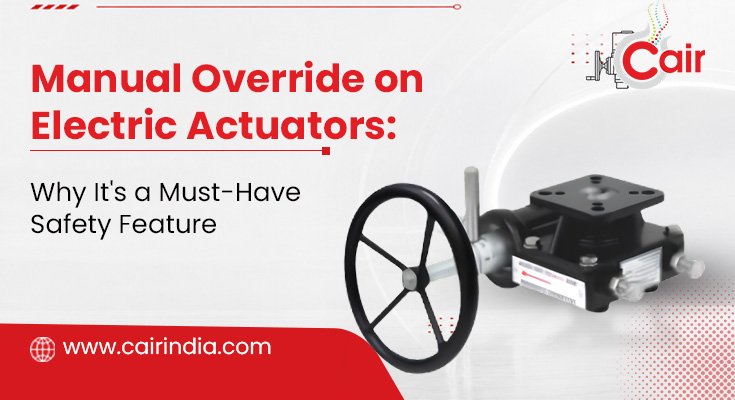
Manual override is a mechanical means of operating an electric actuator – usually via a handwheel, lever, or declutch mechanism – completely independent of electrical power. When engaged, it lets a technician physically move the valve to the position it needs to be in, without waiting for power to be restored or a control signal to arrive.
Most electric actuators are what’s called “stay-put” by design: if power is cut mid-operation, the valve simply stays wherever it was, rather than automatically returning to a safe position. That’s a very different behavior from spring-return or fail-safe actuators, which are engineered to drive the valve to a predetermined safe state on power loss. For stay-put actuators – which make up the majority of standard electric actuator installations – manual override is often the only way to physically move that valve when the power is out.
If you want the broader picture of how electric actuators are built and where fail-safe versus stay-put behavior comes into play, our guide to valve actuators covers the fundamentals in more depth.
Why This Matters More Than People Realize
Power loss doesn’t wait for a convenient moment. Grid outages, tripped breakers, and control system faults happen without warning, and they don’t care whether your process is mid-cycle. If a valve absolutely needs to reach a specific position to prevent over-pressurization, flooding, or a chemical spill, manual override may be the only tool available in that moment.
Actuator or control signal failure is a separate risk from power loss. Even with power present, a failed motor, a burnt-out control board, or a lost PLC signal can leave an actuator unresponsive. Manual override sidesteps the electronics entirely, giving operators a purely mechanical path to move the valve.
Maintenance and commissioning need it too. Technicians frequently need to position a valve precisely during installation, testing, or troubleshooting – long before the automation loop is even wired in. Manual override lets this happen without energizing the actuator at all.
Regulatory and safety standards increasingly expect it. In critical safety systems – emergency shutdown valves, fire protection dampers, boiler feedwater control – the ability to intervene manually isn’t a nice-to-have, it’s often a baseline requirement for the application to be considered safe at all.
This is also why we build manual override into all our explosion-proof electric actuators as standard, given how critical these units typically are to hazardous-area safety systems.
How the Mechanism Actually Works
Most electric actuators use a worm-gear-based manual operation mechanism. Since worm gearing is inherently self-locking (a property we’ve discussed in more depth in the context of gearboxes for valve actuators), it provides the mechanical advantage needed to move even large, heavy valve seats by hand.
The typical procedure looks something like this:
- Isolate the power supply first. Before touching anything, the electrical supply to the actuator must be switched off and locked out. Even during a general power outage, there’s a risk of unexpected re-energization, and a sudden motor start while someone is holding the handwheel can cause serious injury.
- Engage the declutch or override lever. This mechanically disconnects the motor drive train from the gear train, allowing the handwheel to move the valve independently.
- Operate the handwheel in the indicated direction to bring the valve to the required position, checking the position indicator as you go.
- Disengage the override and restore automatic control once the emergency or maintenance task is complete, following the manufacturer’s re-engagement sequence to avoid gear damage.
Skipping the lockout step, or engaging the override without understanding the actuator’s clutch mechanism, is one of the more common causes of gear damage or operator injury in the field – so this isn’t a step to rush through, even in an emergency.
Clutch-Based vs Clutch-Less Manual Override
There are two broad approaches manufacturers use:
Clutch-based override requires the operator to manually engage a declutch lever before the handwheel takes effect, then disengage it afterward to restore motorized control. This is the traditional and most common design.
Clutch-less override allows manual operation without any lever-switching step – the handwheel simply works whenever the motor isn’t actively driving, which can be faster and simpler during emergencies, particularly in fail-safe or spring-return actuator designs used for critical shutoff applications.
Neither approach is universally “better” – it depends on how your actuator is built and what your application demands in terms of response speed during emergencies.
Where Manual Override Is Non-Negotiable
Manual override earns must-have status in a few specific situations:
- Emergency shutdown and safety-critical valves, where a delayed or missed operation could mean over-pressurization, flooding, or a hazardous release
- Remote or hard-to-reach installations, where waiting for a replacement part or restored power isn’t practical
- Hazardous area installations, where explosion-proof and ATEX-rated actuators need a reliable mechanical fallback
- Any valve integrated into a centralized SCADA or PLC system, since a software or communication fault shouldn’t leave a critical valve completely unreachable
If your process involves any of the motorized valve types we manufacture – gate valves, butterfly valves, or control valves – manual override should be a standard line item in your spec, not an optional extra.
Final Thoughts
It’s easy to treat manual override as a footnote on a technical datasheet, but in practice, it’s one of the cheapest insurance policies you can build into a valve automation system. The cost of adding it is negligible compared to the cost of a valve you simply cannot move during a power outage, a control fault, or a genuine emergency.
If you’re specifying electric actuators for a new project, make sure manual override is confirmed for every safety-critical valve in the loop. Browse our complete electric actuator range or check our FAQ page if you’d like help matching the right override mechanism to your application.