
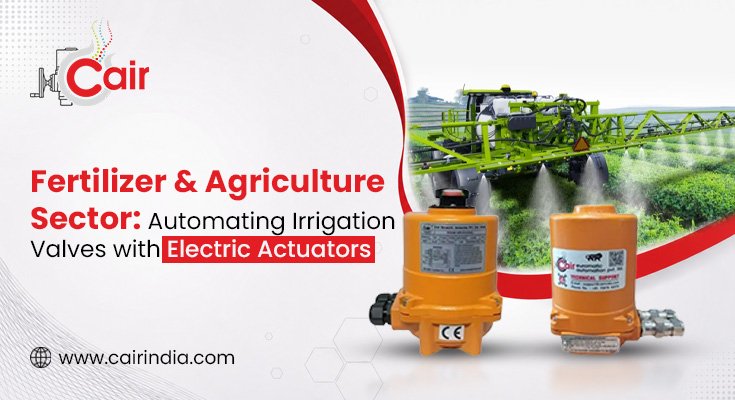
Walk through most large-scale farms or fertilizer processing facilities in India today, and you’ll still find a good number of irrigation valves being opened and closed by hand – someone walking the field, turning a handwheel, guessing at timing based on experience rather than data. It works, but it’s slow, it’s imprecise, and it wastes a resource that’s becoming more expensive by the year: water.
Automating those valves with electric actuators isn’t just a convenience upgrade. For agriculture and fertilizer operations specifically, it changes how precisely water and nutrients get delivered, and that precision translates directly into yield, cost savings, and long-term sustainability.
Why Agriculture Is Catching Up to Industrial Automation
Agriculture uses an enormous share of the world’s freshwater – global estimates put it at around 70% of all freshwater withdrawals – which makes efficient water use one of the biggest levers available for addressing water scarcity in farming. That’s a big part of why precision irrigation and automated valve control have moved from “nice to have” to genuinely necessary as water resources tighten and input costs rise.
The numbers back this up. Field studies on sensor-based and automated irrigation have reported water savings ranging widely by crop and method – some okra and sage studies recorded reductions in the 50–90% range compared to conventional flood or surface irrigation, while broader precision irrigation reviews commonly cite water savings in the 30–60% range without compromising yield. On the fertilizer side specifically, controlled studies of automated drip fertigation have shown reductions of up to 15% in fertilizer input alongside the water savings, without hurting crop output.
None of this happens with a handwheel and a farmer’s best guess. It happens because a valve, tied to a sensor or a controller, opens and closes exactly when and for exactly as long as the crop actually needs.
We’ve written previously about how smart valves are transforming water supply systems more broadly – agriculture is one of the sectors benefiting most directly from that shift.
What an Electric Actuator Actually Adds to an Irrigation Valve
A manual irrigation valve does one thing: it opens or closes when a person turns it. An electric actuator changes that valve into a controllable, remotely operated device that can be tied into a scheduling system, a soil moisture sensor, or a central control panel.
Concretely, this means:
- Scheduled operation – valves open and close automatically at set times, without a person needing to be physically present at every zone
- Sensor-triggered control – valves respond to soil moisture, flow, or pressure readings rather than a fixed calendar, so water is only applied when the crop genuinely needs it
- Remote operation – a large farm or multi-zone fertigation system can be managed from a single control point instead of requiring staff to walk between valves
- Precise, repeatable positioning – modulating actuators can throttle flow to a specific percentage rather than simply being fully open or fully closed, which matters a great deal for fertigation dosing accuracy
For background on how these actuators work mechanically before they’re wired into a control system, our guide to valve actuators is a useful starting point.
Which Valve Types Fit Irrigation and Fertigation Best
Not every valve in an industrial catalog makes sense for a farm or fertilizer plant. A few types show up consistently in these applications:
UPVC and polypropylene ball valves are a strong fit for irrigation lines specifically because of their corrosion resistance – irrigation water often carries dissolved minerals, and fertigation lines carry actual fertilizer chemicals, both of which will degrade metal valves over time far faster than UPVC or PP bodies. Our motorized UPVC/PP ball valve range is built specifically around this kind of chemical exposure.
Butterfly valves are common on larger-diameter main distribution lines where a compact, lightweight valve is preferable to a heavier gate or globe valve, particularly across long field runs where every valve’s weight and footprint add up.
Standard motorized ball valves remain the workhorse for zone-level on/off control, especially where precise throttling isn’t required and simple, reliable open/close operation is enough.
If your fertilizer plant is dosing concentrated or corrosive chemical solutions rather than just irrigation water, it’s worth reviewing our broader UPVC valve range for chemical compatibility before finalizing a spec.
Practical Considerations Before Automating
Power availability in the field. Many agricultural sites don’t have reliable grid power at every valve location, so single-phase actuators, solar-compatible setups, or battery-backed control panels are often part of the real-world spec, not an afterthought.
Weatherproofing. Field-mounted actuators are exposed to sun, rain, dust, and temperature swings in a way that indoor industrial installations rarely are, so an appropriate IP-rated enclosure matters more here than in a controlled plant environment.
Manual override for field servicing. Given how remote some irrigation valves are, having a manual override lever available on the actuator means a technician can still operate the valve locally if a control signal or power supply is temporarily unavailable, without waiting for a truck roll to fix the automation layer first.
Corrosion resistance over cost alone. It’s tempting to specify the cheapest valve body available for a large multi-zone irrigation layout, but fertilizer chemicals and mineral-heavy water will shorten the service life of an incompatible material fast enough to erase any upfront savings within a season or two.
Where This Is Heading
The direction of travel in this sector is toward integrating actuated valves with soil moisture sensors, weather data, and even satellite imagery to schedule irrigation and fertigation automatically, adjusting in real time rather than on a fixed calendar. IoT-based fertigation frameworks have already demonstrated water savings around 30% in field trials by cutting the chronic over-fertigation that manual and fixed-schedule systems tend to fall into. The valve and actuator remain the physical layer that actually executes those decisions – the smarter the upstream sensing gets, the more that precision depends on having a reliable, accurately controllable valve underneath it.
Final Thoughts
Automating irrigation and fertigation valves isn’t about replacing farmers’ judgment with technology for its own sake – it’s about giving that judgment a more precise tool to act on. Whether you’re running a large farm, an agri-processing facility, or a fertilizer blending plant, the combination of a corrosion-resistant valve body and a properly specified electric actuator is what turns “watering on a schedule” into “watering exactly what the crop needs, when it needs it.”
If you’re planning an automation upgrade for irrigation or fertigation lines, browse our complete product range or check our FAQ page for guidance on matching valve materials and actuator specs to your field conditions.