
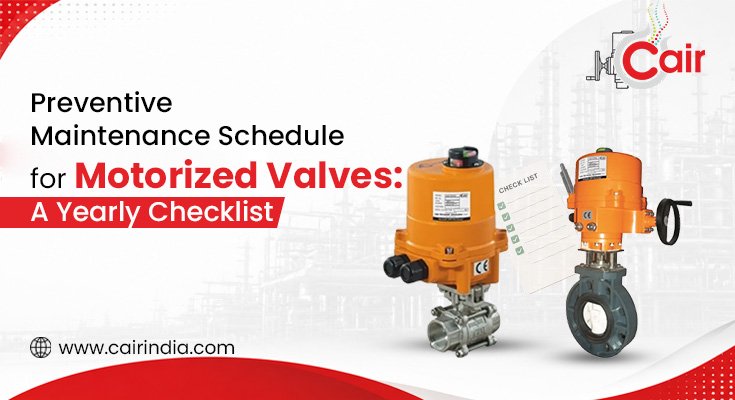
There’s a pattern that shows up again and again in plant maintenance logs: valves get attention when they fail, not before. A motorized valve seizes up, an actuator overheats, a limit switch stops reporting position correctly – and only then does anyone go looking for the root cause. By that point, you’re usually looking at unplanned downtime, an emergency callout, or both.
A structured preventive maintenance schedule flips that sequence. Instead of reacting to failures, you’re catching the early signs – a stiff stem, a slightly slow stroke time, a loose terminal connection – months before they turn into a shutdown. We’ve covered how to diagnose and fix problems after they happen in our guide to common motorized valve problems; this piece is about avoiding that call in the first place.
Why a Documented Schedule Matters More Than “Checking In Occasionally”
Preventive maintenance only works if it’s actually scheduled, tracked, and followed – not left to whoever remembers to walk past a particular valve. Data from the U.S. Department of Energy’s operations and maintenance best practices research suggests a properly implemented preventive maintenance program can cut maintenance costs by roughly 12–18% and extend equipment life by 20–25% compared to a purely reactive approach. That’s a meaningful number when you’re managing dozens or hundreds of motorized valves across a facility.
The other benefit is less about cost and more about predictability: a documented schedule means you know exactly when a valve was last inspected, what was checked, and what to expect at the next interval – instead of relying on institutional memory that walks out the door when a technician changes jobs.
Monthly Checks
These are quick, low-effort checks meant to catch obvious problems early:
- Visual inspection of the actuator housing and valve body for corrosion, cracks, dents, or oil/fluid leakage around seals and connections
- Confirm position indicators match the actual valve position – a mismatch here is often the first sign of a slipping coupling or a miscalibrated limit switch
- Listen for unusual motor noise during operation, which can indicate bearing wear or a developing mechanical fault
- Check for water ingress in the actuator’s terminal compartment, particularly in outdoor or humid installations
Quarterly Checks
A slightly deeper pass, still without a full teardown:
- Partial stroke testing – cycle the valve through a partial range of motion to confirm it moves smoothly without sticking, especially important for valves that sit in one position for long stretches between operations
- Check mounting bolts, nuts, and screws for tightness and any signs of vibration-related loosening
- Inspect the local control panel – confirm open/close/stop buttons respond correctly and indicator lamps function
- Review historical torque and cycle data if your actuators log this, comparing current performance against baseline figures to catch gradual degradation before it becomes a failure
- Verify limit switch box calibration, since drift here is one of the more common causes of valves stopping short of fully open or fully closed
Semi-Annual Checks
At the six-month mark, it’s worth going a level deeper:
- Lubricate the valve stem and gearbox according to manufacturer specifications – this is especially important for worm gearboxes, where dried-out lubrication accelerates wear on the self-locking mechanism
- Inspect gland packing and seals for signs of wear, and adjust or replace as needed to prevent leakage
- Test the manual override mechanism to confirm it engages and disengages cleanly – the worst time to discover a stuck override lever is during an actual power outage
- Check terminal connections inside the actuator housing for tightness, corrosion, or heat discoloration, which can indicate a developing electrical fault
Annual Overhaul
This is the most thorough pass of the year, and typically the one that requires a planned shutdown window:
- Full teardown inspection of internal actuator components, gearing, and seals
- Complete calibration verification of any positioners or modulating control components, confirming output matches input signal across the full range rather than just at the end positions
- Seat and disc/ball inspection for wear, pitting, or scale buildup that could compromise sealing
- Insulation and high-voltage testing on the actuator motor windings, catching insulation degradation before it causes a motor failure
- Full re-lubrication and repacking as part of a complete service, rather than spot lubrication done during quarterly checks
- Documentation review – update maintenance records, compare this year’s findings against previous years, and flag any valve showing a pattern of recurring issues for closer attention or replacement consideration
For background on how these mechanical and electrical systems work together in the first place, our guide to valve actuators is a useful reference before diving into a deeper annual inspection.
Adjusting Frequency Based on Criticality
Not every valve in a plant deserves the same inspection intensity. A general guideline followed across process industries is to scale frequency to risk and duty:
| Valve Category | Typical Inspection Frequency |
| Critical/safety valves (emergency shutdown, fire protection) | Monthly to quarterly, with annual full overhaul |
| High-cycle valves (frequent operation) | Quarterly, given faster wear accumulation |
| Standard process valves | Quarterly to semi-annual |
| Low-duty or standby valves | Semi-annual to annual |
Valves handling high pressure, corrosive media, or safety-critical shutoff duty should always be pushed toward the more frequent end of their category – the cost of an extra inspection is negligible compared to the cost of an unplanned failure in a critical service.
Building This Into a Habit, Not a One-Off Project
The single biggest failure point in preventive maintenance programs isn’t a lack of knowledge about what to check – it’s a lack of consistency in actually doing it. A checklist that lives in a filing cabinet or a forgotten spreadsheet doesn’t prevent anything. Whether you use a CMMS platform, a simple shared calendar, or a physical logbook at each valve station, the key is making the schedule visible, assigned to a specific person, and tracked over time so gaps get noticed before they turn into failures.
If you’re seeing recurring issues on the same valve despite following a maintenance schedule, it might be worth revisiting whether that valve was correctly specified for the application in the first place – our guide on common mistakes with industrial valves covers this exact scenario.
Final Thoughts
A yearly preventive maintenance schedule for motorized valves isn’t about adding bureaucracy to your maintenance program – it’s about converting unpredictable, expensive emergency repairs into small, planned, low-cost tasks. Monthly visual checks, quarterly functional tests, semi-annual servicing, and a full annual overhaul together form a rhythm that catches problems while they’re still cheap to fix.
If you’d like help setting up an inspection schedule tailored to your specific valve and actuator combinations, browse our complete product range or check our FAQ page for guidance on service intervals for your equipment.