

What is a Butterfly Valve?
A butterfly valve is a type of valve used to regulate or control the flow of fluids, gases, or slurries within a pipeline. It consists of a circular disc or “butterfly” that pivots around a central axis. When the valve is closed, the disc is perpendicular to the flow, blocking it, and when opened, the disc is parallel to the flow, allowing it to pass through.
Butterfly valves are popular for on-off or modulating services due to their lightweight design, small installation footprint, lower cost, quick operation, and large orifice sizes. These valves are used in pipelines to shut off flow and are commonly used in water supply, collection, distribution, pumping stations, and flow isolation.
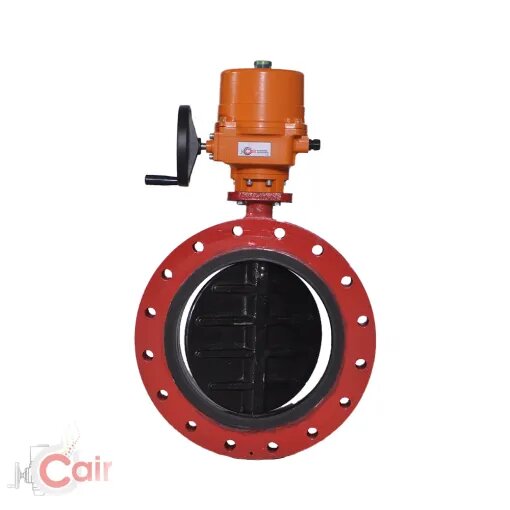
Their simple construction is characterized by their simple construction and compactness, resulting in lighter weights, lower costs, smaller installation footprints, and faster actuation speeds. The valves are flanged double eccentric type, which involves two offsets of the disc from the valve body’s center or the axis of rotation of the stem.
The Body Parts of the Butterfly Valve:
Butterfly Valves are a type of valve that operates by controlling fluid flow through a series of components.
Valve Body:
This component fits between pipe flanges, with common end connection types being flanges double lug, and wafer types.
Disc:
It functions as a gate that stops or throttles fluid flow. Variations in disc design, orientation, and material can improve flow, sealing, and operating torque.
Seat:
It secures the internal valve body in the closed position to achieve complete shut-off, stainless steel weld-filled and micro-finished integral body seat ensures a corrosion and erosion-resistant seat face.
Stem:
This component connects the disc to the actuation mechanism and transmits the torque through itself.
Seals:
It presents at multiple interfaces within the valve to ensure a tight seal during operation or to isolate the process media from the valve’s internal components.
A continuous T-profile resilient sealing ring is held on the periphery of the disc by a retaining ring, preventing the sealing ring from rolling out.
The valve features a T-profile resilient sealing ring on the seat face, which prevents rolling out and provides a tight seal in both closed and open positions. The multiple O-ring shaft sealing system ensures maintenance-free sealing throughout the valve’s life.
Other common components include bushings, bearings, and fasteners. The actuation section covers details on the handle, lever, gearbox, and handwheel on the actuation end. The valve’s design eliminates interaction between process media and stem/shaft, ensuring a maintenance-free seal.
The Working Principle of Butterfly Valve:
The construction of a Butterfly Valve is relatively simple, with the rotation of the valve disc. In the closed position, the disc closes the valve bore, in the open position, the disc is perpendicular to the flow direction to allow flow. Butterfly valves generally provide bi-directional flow and shut-off capability.
However, they are not full-bore, which makes them unsuitable for piping or swabbing. The body is made of ductile iron, and both the interior and external surfaces are coated with epoxy powder. Handwheels, gears, actuators, or a mix of the three are commonly used to operate the valves, depending on the individual application need and technical specifications. We will be discussing the actuation methods later in the article.
The Actuation Method of Butterfly Valves:
There are multiple ways to operate or actuate a butterfly valve- manually, semi-manually, or fully electric.
Electric: these butterfly valve types use an electric actuator to control the valve with a 4-20mA control signal and are typically used for high-precision regulation and time-sensitive applications.
Pneumatic: Also used for high-precision application and uses compressed air for actuation.
Hydraulic: Typically used for applications requiring large torques for opening and closing the valve, such as high-pressure and high-viscosity applications.
Manual: Manually operated butter valves make use of a handwheel, crank, or lever to cooperate with the valve. Smaller manual valves are typically fitted with a lever. For larger sizes, handwheels are provided and are accompanied by a gearbox to transfer the torque with a high mechanical advantage.
Another way of manual actuation is in use cases where the valve is buried underground without a manhole; in such applications is done with an extension spindle, adapter/ square cap, and corresponding T-key from the ground level.
Due to inherently lower torque requirements, sizing and installing actuators are less expensive for butterfly valves compared to others, like gate valves.
Also check our Another Blog: Butterfly Valve Vs Gate Valve
A: dvantages of Butterfly Valves:
Depending on the application, butterfly valves can offer significant advantages over other types of valves, especially for dimensions in size:
Lightweight and Compact: with a compact design and a smaller face-to-face dimension, butterfly valves have a considerably smaller installation footprint and offer savings in the form of lower installation costs including labor cost, equipment, and piping support.
Fast Acting: a 90’ rotation of the handle, or the actuation mechanism, provides a complete closure or opening of the valves. However, with larger butterfly valves, a gearbox is often required as part of the actuation mechanism which reduces the operational torque and simplifies the operation of the valve but comes at the expense of speed.
Low Cost: owning to their simple design, butterfly valves require less material are simpler to design and manufacture, and are often the more economical choice compared to other valve types. The cost savings are mainly realized in larger valve sizes, typically above DN 300.
Versatility: Butterfly valves have a wide variety of use cases including the ability to be installed underground.
Explore our website Cair Euro Automation to learn more about the types of Butterfly Valves that we offer. We are the leading Butterfly Valve Manufacturer in Ahmedabad, India. Contact us to get a quote!