
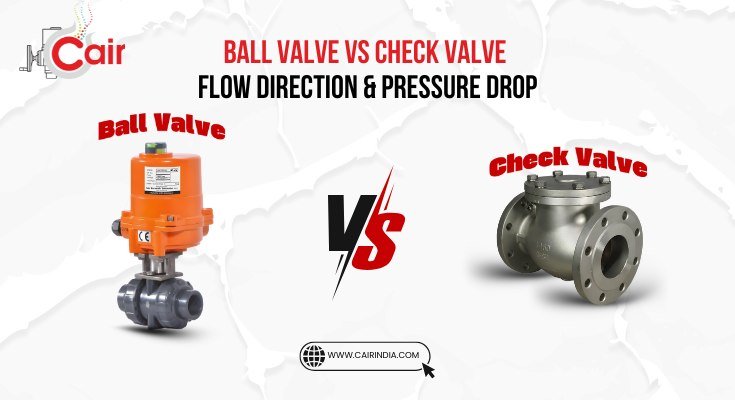
Choosing the right valve matters more than most people realize. Pick the wrong one and you’ll pay for it later — with downtime, wasted energy, or even damaged equipment. In short: ball valves and check valves both control fluids, but they do very different jobs. One gives you active control; the other protects the system automatically. Understanding those differences — and how each affects pressure drop — is essential for reliable, efficient systems.
Quick snapshot: ball valve vs check valve
| Feature | Ball Valve | Check Valve |
| Main job | Isolation and flow control (on/off or some throttling) | Automatic prevention of backflow |
| Operation | Active — manual, pneumatic, or electric | Passive — opens/closes with flow |
| Flow direction | Usually bidirectional | Strictly unidirectional |
| Pressure drop | Very low (especially full-bore) | Moderate to high (depends on design) |
| Typical use | Isolation, pigging, automated control | Pump protection, backflow prevention |
| Maintenance | Periodic seal/packing checks | Inspect internals (hinges, springs) |
Why these valves are not interchangeable
A ball valve is an isolation device. You open it when you want flow and close it when you don’t. A check valve is a guardian — it closes automatically if flow tries to reverse. If a pump fails, a ball valve won’t act fast enough to stop reverse flow; a check valve will. Mixing these up is a common—and costly—mistake.
Ball valve — the practical view
A ball valve uses a spherical plug with a hole through it. Turn the ball 90°, and you either line the hole up with the pipe (open) or block the flow (closed). The design is simple and rugged.
Key points:
- Full-bore (full-port) valves match the pipe bore, so pressure drop is almost zero. Great for pigging and energy-sensitive lines.
- Reduced port valves are smaller and cheaper but add some pressure loss.
- Floating ball vs trunnion-mounted: floating balls are fine for medium pressure. Trunnion-mounted designs are better for large, high-pressure lines because the ball is supported top and bottom.
- Actuation: manual handles are common, but electric or pneumatic actuators make sense where remote or automated control is needed.
Materials & seals
Common materials: cast iron, carbon steel (WCB), stainless steel (CF8 / CF8M), brass, and plastics (PVC). Seats and seals are usually PTFE variants, TFM, PEEK, or other engineered plastics depending on temperature, pressure, and chemistry.
Check valve — the practical view
A check valve opens when upstream pressure pushes the closure member off its seat. If pressure drops or reverses, the closure snaps back and stops the flow. No operator needed.
Types:
- Swing check: low pressure drop, good for steady flow and large pipes.
- Lift check: used in vertical piping and high-pressure systems.
- Ball check: good with viscous fluids and slurries; self-cleaning action.
- Dual-plate (wafer): compact, good where space is limited.
- Silent/non-slam: spring-assisted closure that helps prevent water hammer.
Remember: check valves are directional — they usually have an arrow on the body showing the flow direction. Install them wrong and the system won’t work.
Pressure drop — Cv, Kv, and why it matters
Pressure drop through a valve behaves like a tax on your pump. We quantify capacity with Cv (U.S. units) or Kv (metric). They’re related:
Cv = 1.156 × Kv
For liquids, pressure drop is:
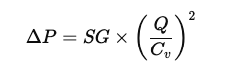
Where:
- ΔP = pressure drop (psi)
- Q = flow (GPM)
- SG = specific gravity (water = 1.0)
- Cv = flow coefficient
Real examples (step-by-step)
Example 1: — 4″ full-bore ball valve: assume Cv = 1200, Q = 500 GPM, SG = 1.0.
- Compute Q/Cv = 500 / 1200 = 0.4166667
- Square it: 0.4166667² = 0.1736111
- ΔP = 1.0 × 0.1736111 ≈ 0.17 psi
Example 2: — 4″ reduced-bore ball valve: Cv = 700.
- Q/Cv = 500 / 700 = 0.7142857
- Square: 0.7142857² = 0.5102041
- ΔP ≈ 0.51 psi
Example 3: — 4″ swing check: Cv = 400.
- Q/Cv = 500 / 400 = 1.25
- Square: 1.25² = 1.5625
- ΔP ≈ 1.56 psi
So, moving from a full-bore ball to a typical swing check raises the pressure drop from about 0.17 psi to 1.56 psi — a large increase. Over a 24/7 pumping system, those extra psi add up to real energy cost.
Practical selection guide
Use a ball valve when:
- You need tight isolation or pigging.
- Energy efficiency matters (choose full-bore).
- You want automated on/off control.
Use a check valve when:
- You need guaranteed automatic backflow protection (pump discharge).
- You must prevent reverse flow when power or control fails.
Common mistakes:
- Relying on an automated ball valve to prevent pump backflow — it won’t close fast enough.
- Picking a swing check for a vertical-down line — gravity can stop it from seating.
- Sizing by pipe diameter alone — always size by flow rate and Cv.
Installation & maintenance notes (simple checklist)
Ball valve:
- Prefer stem vertical to avoid sediment in packing.
- Tighten flange bolts in a star pattern to spec.
- Flush piping before first operation.
Check valve:
- Confirm arrow direction before installation.
- Give enough clearance for disc/flap movement.
- Swing checks: ensure hinge pin orientation is correct (usually horizontal).
Maintenance:
- Cycle isolation valves occasionally (at least every 6 months) to prevent sticking.
- Inspect check valves annually, or more often in high-cycle systems.
Quick FAQs
Q.Can a ball valve replace a check valve?
A. Only if you don’t need automatic backflow prevention.
Q. Which has lower pressure drop?
A. Full-port ball valves.
Q. How often to check valves?
A. Annually for most; semi-annually for high-pressure/high-cycle systems.
Q. What causes water hammer?
A. Fast/clumsy check valve closure or a valve that slams; a silent check helps.