
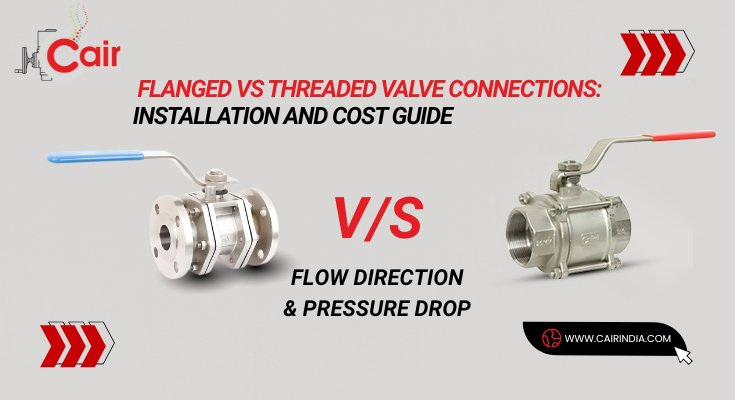
Why Valve Connection Choice Is More Important Than It Looks
In industrial piping, people often focus on valve type, pressure rating, or actuator selection. The connection itself usually gets less attention. In reality, that connection is what holds the entire system together. A valve can be perfectly designed, but if the connection is wrong for the service conditions, problems will eventually show up.
For manufacturers and system integrators like Cair Euromatic Automation, valve connections are not just mechanical joints. They carry load, absorb vibration, and support actuators that operate repeatedly under pressure. Over time, these stresses add up. This is why choosing between threaded and flanged connections is a decision that affects safety, maintenance effort, and overall plant reliability.
Industrial pipelines move fluids that are rarely gentle. Pressure spikes, temperature changes, pump vibrations, and chemical exposure are normal operating conditions. The type of connection used determines how well the system handles all of this without leaking or loosening. Threaded connections work well in smaller systems, while flanged connections are built for heavy-duty industrial use. Understanding where each one fits is the key.
Threaded Valve Connections: Simple, Fast, but Limited

Threaded valve connections are widely used because they are easy to install and relatively low in cost. They rely on mating internal and external threads to create a mechanical joint. Because no welding or heavy tools are required, threaded valves are common in small-bore pipelines, typically below 2 inches.
In many utility systems, this simplicity is a major advantage. Installation is quick, and replacement does not require specialized equipment. However, threaded connections also come with limitations that engineers must keep in mind, especially in industrial environments.
Tapered and Parallel Threads in Real Applications
Most industrial threaded valves use either NPT or BSP thread standards. NPT threads are tapered, meaning the thread diameter increases slightly as it goes deeper. This taper allows the threads to wedge tightly together, which helps create a seal.
BSP threads can be tapered (BSPT) or parallel (BSPP). Parallel threads do not seal on their own and need an additional sealing element like an O-ring or gasket.
One mistake that still happens on sites is mixing NPT and BSP threads. Even though they may appear to fit initially, the difference in thread angle and pitch almost always results in leaks or damaged threads later on. Once that happens, repairs become time-consuming.
Why Thread Sealants Are Always Needed
Even when threads fit well, they are not perfectly leak-tight. Machined threads have tiny gaps that create a spiral leak path along the joint. To block this path, sealants are used.
PTFE tape is common and works well when applied correctly. Too much tape, however, can cause problems, especially in control valves where loose fragments may enter internal passages. Liquid thread sealants provide better resistance to vibration but make disassembly harder after long service.
Structural Weakness of Threaded Joints
Cutting threads into a pipe removes material from the wall, which reduces its pressure capacity. This is one reason threaded valves are usually limited to lower pressure services or used with thicker pipe schedules.
Over time, vibration and temperature cycling can cause threaded joints to relax slightly. This often leads to small leaks rather than sudden failures, but even minor leakage can be unacceptable in many industrial processes.
Flanged Valve Connections: Built for Industrial Demands
Flanged connections are designed with strength and serviceability in mind. Instead of relying on threads, a flanged joint uses two flanges, a gasket, and bolting to create a sealed connection.
This design makes flanged valves suitable for high pressure, large pipe sizes, hazardous fluids, and automated systems where reliability is critical.
Common Flange Types Used in Plants

- Weld Neck Flanges
These are commonly used in high-pressure and high-temperature services. The tapered neck distributes stress smoothly from the flange into the pipe, which reduces fatigue. - Slip-On Flanges
Easier to align and install, but they have lower fatigue strength. Usually found in lower-pressure systems. - Socket Weld Flanges
Often used in small, high-pressure lines. They are compact but can trap corrosive fluids if not properly managed. - Blind Flanges
Used to close off pipe ends or isolate sections of piping. Since they hold full system pressure, proper bolting is critical.
How Gasket Sealing Works in Practice
In flanged joints, sealing depends entirely on gasket compression. When bolts are tightened, the gasket material is squeezed and flows into surface imperfections on the flange faces. This creates a pressure-tight seal.
The gasket material must match the service conditions. A gasket suitable for water may fail quickly in steam or chemical service. In demanding applications, spiral wound or metal ring gaskets are used because they can maintain sealing force even during pressure surges and temperature changes.
Flange Face Types and Their Purpose
Flat face flanges are usually used with cast iron or plastic components to avoid bending. Raised face flanges concentrate pressure on the gasket, improving sealing in higher-pressure services. Ring-type joints are reserved for extreme conditions such as oil and gas or high-pressure steam systems.
Installation Practices That Make the Difference
Installing Threaded Valves Correctly

Threaded installation should always start with a dry fit. The valve should screw on smoothly by hand. If it does not, forcing it with a wrench usually causes damage.
Sealant must be applied in the correct direction so it does not unravel during tightening. Final tightening follows the “turns past finger tight” method rather than fixed torque values, since friction varies with material and sealant type.
Installing Flanged Valves Properly

Flanged installation requires more care. Flange faces must be clean and aligned correctly. Bolts should be lubricated to ensure the applied torque actually produces clamping force.
Bolts are tightened in a cross pattern and in stages. This keeps the gasket evenly compressed. After the first thermal cycle, re-torquing is often recommended because gaskets can relax slightly under load.
Cost Comparison: Looking Beyond Purchase Price
Threaded valves are cheaper upfront. They require fewer parts and less installation time, making them attractive for small systems and utility services.
Flanged valves cost more initially because of flanges, bolts, and gaskets. However, maintenance is usually faster and easier. Removing a flanged valve is straightforward, while a seized threaded valve may require cutting the pipe, increasing downtime and repair cost.
In Indian industrial regions such as Gujarat and Maharashtra, skilled labor availability also plays a role. Flanged installations benefit more from experienced technicians and proper torque tools.
Actuation, Vibration, and Connection Stability
When electric actuators are added, connection stability becomes even more important. Actuators add weight and apply torque during operation. In threaded joints, this load is concentrated at the first engaged thread, which is already a weak point.
Flanged connections distribute these loads across multiple bolts and a wider area. This reduces stress on the pipe and improves long-term reliability, especially in systems with frequent cycling or vibration.
Indian Standards and Compliance Requirements
In India, valve connections must follow BIS standards such as IS 13095, IS 14846, and IS 9890. These standards define acceptable connection types, pressure ratings, and testing requirements.
For government and PSU projects, ISI-marked valves are often mandatory. Compliance ensures interchangeability and long-term safety across different manufacturers and suppliers.
Maintenance, Lifecycle, and New Technologies
From a maintenance point of view, flanged valves are easier to service. They can be removed without rotating the valve body or disturbing adjacent piping. This is critical in plants where downtime is expensive.
Modern developments such as smart gaskets, IIoT sensors, and AI-enabled actuators are further improving reliability. These technologies help detect bolt relaxation, leakage, and abnormal torque patterns before failures occur.
Final Recommendation
Threaded valve connections are best suited for small, low-pressure systems where simplicity and cost are the main priorities.
For industrial systems involving high pressure, hazardous fluids, or electric actuation, flanged connections are the safer and more reliable choice. They offer better load distribution, easier maintenance, and higher resistance to vibration and thermal stress.
For companies like Cair Euromatic Automation, combining strong flanged designs with modern actuation and monitoring technologies ensures systems that perform reliably today and remain ready for future industrial demands.