
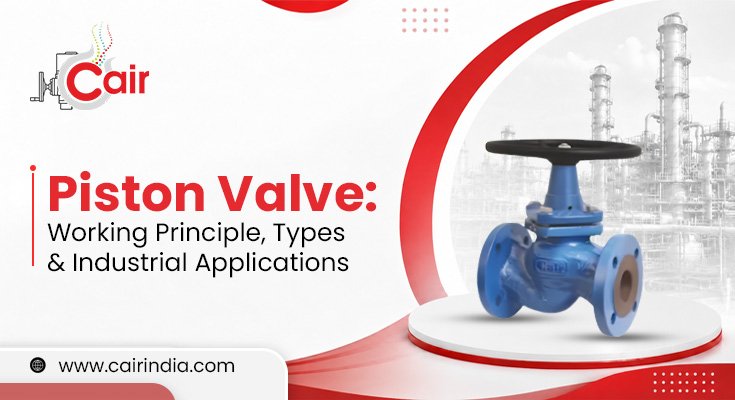
Steam service has a way of exposing weak valve designs fast. High temperatures, thermal cycling, and the constant risk of leakage past a stem gland push most conventional valves toward frequent maintenance and shortened service life. The piston valve exists specifically to solve that problem – and it does it with a mechanism that’s genuinely different from the gate, globe, or ball valves engineers usually reach for first.
If you’ve never had a reason to look closely at how a piston valve actually works, this is worth five minutes of your time, especially if steam, thermic fluid, or high-temperature process lines are anywhere in your plant.
What Is a Piston Valve?
A piston valve is a linear-motion shut-off valve that uses a cylindrical piston, rather than a wedge or disc, to control flow. The piston travels vertically between an upper and a lower sealing ring, separated by a lantern bushing that supports the piston as it moves. When the piston sits against the lower ring, the valve is closed and flow is blocked. When it rises to align with the upper ring, flow passes freely through the valve body.
The defining feature – and the reason piston valves get specified for demanding steam and thermal service in the first place – is the glandless sealing design. Instead of relying on a packed gland around the stem (a classic leak point on most linear-motion valves), the piston valve’s own sealing rings do double duty: they seal the valve port to stop flow, and they simultaneously seal the stem to the atmosphere as the piston passes through the upper ring. There’s no separate packing to compress, adjust, or eventually wear out and leak.
This is exactly the design our own glandless piston valve range is built around – leak-tight sealing across the port and to atmosphere, a notably large effective sealing area compared to conventional linear-motion valves, and no erosion of the sealing surface even under continuous steam and hot water service.
Why the Glandless Design Matters So Much
Conventional linear-motion valves – gate and globe valves included – typically rely on a stuffing box or gland packing around the stem to prevent leakage to atmosphere. That packing is a maintenance item: it compresses over time, needs periodic tightening or replacement, and remains a persistent (if usually minor) leak path, particularly under thermal cycling where the stem repeatedly expands and contracts.
A glandless piston valve removes that failure point entirely. Because the piston itself seals against precision sealing rings rather than relying on compressed packing, there’s genuinely no leakage path to atmosphere through the stem – which is a large part of why piston valves have become the standard choice for saturated and superheated steam service, where even small chronic leaks translate into real energy loss and safety concerns over time.
Balanced vs Unbalanced Piston Valves
Piston valves come in two structural configurations, and the distinction matters a great deal once you move beyond small bore sizes:
Unbalanced piston valves are the simpler configuration, typically used for smaller valve sizes – generally below 2 to 2.5 inches nominal bore. At this size, the force required to overcome inlet pressure and move the piston stays within a manageable range for standard actuation.
Balanced piston valves address a problem that shows up as valve size increases: at larger bore diameters, the torque needed to open or close an unbalanced piston against full inlet pressure becomes impractically high. Balanced piston valves solve this by equalizing pressure above and below the piston, dramatically reducing the operating torque required, even at larger sizes. This is what makes larger-diameter piston valves practical to automate with a reasonably sized actuator rather than requiring an oversized, expensive one.
Key Design Features Worth Knowing
A few structural details are worth understanding before you spec a piston valve for a project:
- Replaceable sealing rings – the sealing rings can typically be serviced or replaced without removing the entire valve from the pipeline, which meaningfully reduces both maintenance downtime and lifecycle cost compared to valves that require full removal for reseating.
- Reinforced sealing rings with spring-loading – many designs use Belleville washers or similar spring elements behind the sealing rings, compensating for thermal expansion and contraction so the seal stays tight across a wide temperature range rather than loosening as the system heats and cools.
- Insensitivity to media impurities – because sealing relies on a compressed ring system rather than a fine machined metal-to-metal fit, piston valve sealing performance holds up even with minor dirt or particulate in the media, unlike some precision-seat valve designs.
- On/off and throttling capability – piston valves aren’t limited to simple shutoff duty; the same linear mechanism supports moderate throttling applications as well.
Where Piston Valves Actually Get Used
Piston valves show up overwhelmingly in high-temperature, high-reliability steam and thermal fluid applications:
- Power plants – main steam isolation on steam headers, where reliability and leak-tightness directly affect plant efficiency and safety
- Refineries and petrochemical plants – steam manifolds and process steam distribution
- Pulp and paper mills – saturated and superheated steam service supporting continuous process operations
- Pressure reducing stations – where consistent, leak-free shutoff matters for downstream pressure control
- Thermic fluid systems – supply, return, and balancing line isolation, where our glandless piston valve is specifically built for these thermal fluid duties
- Desuperheaters and steam traps – supporting equipment where consistent sealing under thermal cycling is essential
For automated operation in these same services, we also manufacture a motorized Y-type control valve with electrical actuator built on the same piston-based sealing principle, giving you remote or modulating control without giving up the glandless sealing advantage.
Piston Valve vs Other Linear-Motion Valves
It’s worth briefly placing piston valves in context against the other linear-motion valves in our range. We’ve covered how piston valves stack up specifically against gate valves – sealing method, torque behavior, and suitability for aggressive or high-temperature media – in our dedicated comparison, Piston Valve vs. Gate Valve: Differences, Advantages & Applications, which is a useful next read if you’re actively deciding between the two for a specific project. In short: gate valves offer minimal flow restriction and lower cost for general isolation duty, while piston valves earn their higher price tag specifically in steam, thermal fluid, and other services where zero-leakage sealing and thermal-cycling durability matter more than upfront cost.
Final Thoughts
Piston valves aren’t a general-purpose replacement for gate or globe valves – they’re a purpose-built solution for a specific, demanding problem: reliable, leak-free shutoff in steam and high-temperature thermal fluid service, without the chronic maintenance burden of gland packing. If your plant runs steam headers, thermic fluid loops, or pressure-reducing stations, this is a valve family worth specifying deliberately rather than defaulting to whatever’s already on the shelf.
If you’re evaluating piston valves for a steam or thermal fluid application, browse our complete manual valve range or check our FAQ page for guidance on sizing and configuration.