
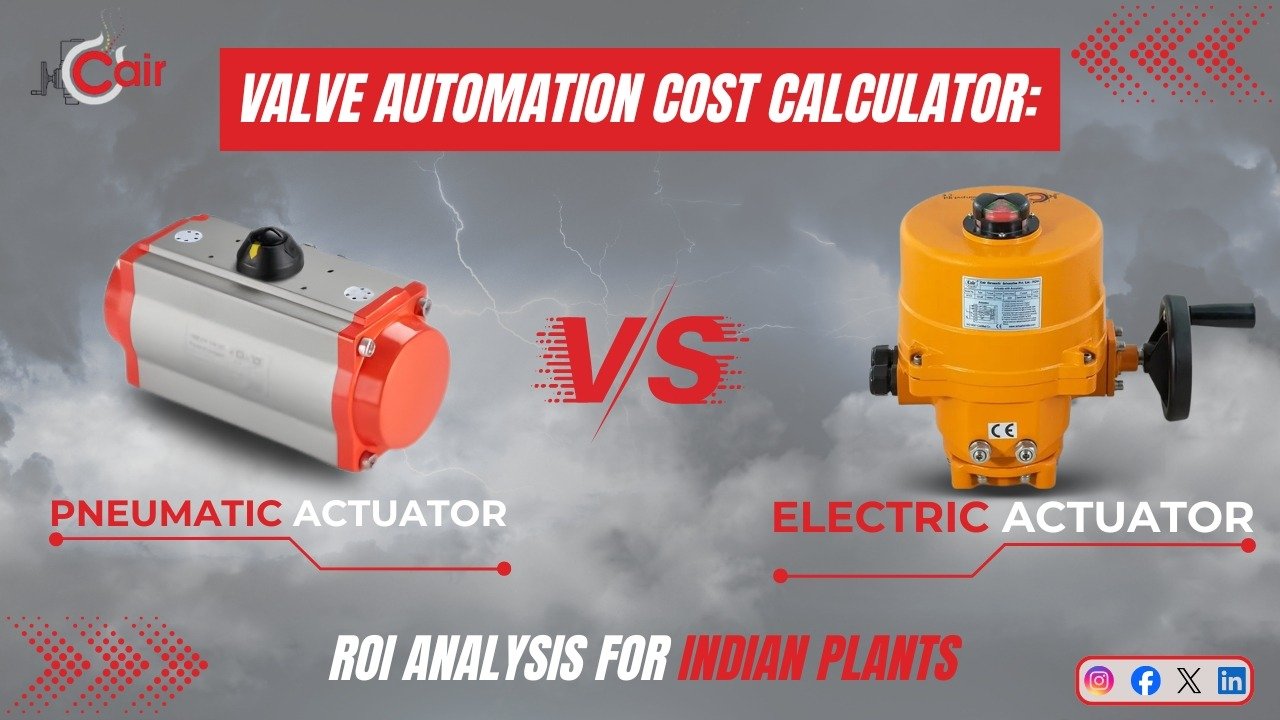
Every plant manager in India has heard it at some point: “Sir, pneumatic toh sasta hai — electric kyun lena?” It is a fair question, and on paper, it sounds completely logical. A pneumatic actuator’s sticker price is often lower. But here’s the thing about paper — it does not pay your electricity bill, your compressor maintenance invoice, or the cost of a mid-shift production shutdown.
The real cost of valve automation is never just the price tag on the box. It is the sum of everything you pay over the next 10 years: energy, maintenance, downtime, infrastructure, and the slow, invisible bleed of compressed air leaking out of aging pipelines at 3 AM when no one is watching.
India’s industrial electric actuator market is projected to reach USD 517 million by 2033, growing at approximately 8.2% CAGR, driven by Make in India initiatives, PLI schemes, and the rapid expansion of process automation across water treatment, pharmaceuticals, chemicals, and power generation [1]. The shift is real — and the economics are driving it.
In this guide, we give you the exact ROI framework, real INR-denominated cost tables, and a step-by-step calculator so you can walk into your next CAPEX review with data — not assumptions. This is the analysis your CFO has been waiting for.
| Key Insight: Most engineers compare CAPEX only. But in valve automation, OPEX over 10 years typically costs 3–5x the original purchase price. The real decision lives in the lifecycle cost — not the day-1 invoice. |
Why This Comparison Matters More Than Ever for Indian Industry
India’s industrial landscape is changing faster than most people realise. The combination of stricter energy efficiency mandates, rising electricity tariffs, and government push for domestic automation is fundamentally altering the economics of valve selection at Indian plants.
According to the Bureau of Energy Efficiency (BEE), Ministry of Power, India, compressed air systems account for 15–20% of total industrial electricity consumption in Indian manufacturing facilities [2]. More critically, BEE estimates that average compressed air leakage in Indian plants exceeds 25–35% of total air production — significantly higher than global benchmarks — due to aging infrastructure, poor maintenance schedules, and inadequate leak detection programs.
That leaking air is not just inefficiency. It is money your plant pays every single month, year after year, for zero productive output. And it is money that electric actuator systems simply do not spend.
Add to this the GST Input Tax Credit (ITC) benefit available on capital equipment purchases for registered industrial buyers — which reduces effective CAPEX by 18% — and the Make in India procurement preference for domestically manufactured equipment like Cair Euromatic’s actuator range, and the financial case for electric becomes even more compelling for Indian plants specifically.
| India Market Fact: The Indian electric actuator market was valued at USD 245 million in 2023 and is expected to more than double to USD 517 million by 2033. Source: Industry research reports [1]. This growth is being led by water treatment, pharma, oil & gas, and power sectors. |
The Real Cost Structure: CAPEX vs OPEX — What Most Engineers Miss
Before we get into numbers, it is important to understand how valve automation costs are structured. There are two layers to every decision:
• CAPEX (Capital Expenditure): The one-time purchase and installation cost — the actuator unit, wiring or air piping, accessories, and installation labour. This is what most comparison discussions stop at.
• OPEX (Operating Expenditure): The recurring costs over the system’s operational lifetime — energy consumption, maintenance, spare parts, and the financial impact of unplanned downtime. This is where the real story is told.
A pneumatic actuator might cost ₹15,000 on day one. An electric actuator might cost ₹22,000. If you stop there, pneumatic wins. But when you add 10 years of compressed air costs, FRL replacements, solenoid valve failures, and monsoon-related moisture damage — the picture completely reverses.
Pneumatic Actuator: Complete Cost Breakdown for Indian Plants
CAPEX — What You Pay on Day 1
The upfront cost of a pneumatic actuator system is more than the actuator unit alone. For a proper apples-to-apples comparison, you need to include every component required to make the system operational:
| Cost Component | Typical INR Range (Per Valve Point) |
| Pneumatic actuator unit (quarter-turn, medium size) | ₹4,000 – ₹18,000 |
| Solenoid valve (5/2-way, per actuator) | ₹1,500 – ₹5,000 |
| Air filter-regulator-lubricator (FRL) unit | ₹2,000 – ₹6,000 |
| Compressed air piping to valve location | ₹3,000 – ₹12,000 |
| Air compressor infrastructure (amortised per point) | ₹8,000 – ₹25,000 |
| Limit switch / position feedback accessories | ₹2,000 – ₹6,000 |
| Estimated Day-1 Total (per valve point) | ₹20,500 – ₹72,000 |
OPEX — The Hidden Costs That Compound Annually
This is where the analysis gets uncomfortable for pneumatic advocates. The following recurring costs apply to every single pneumatic actuator point in your plant, every single year:
1. Compressed Air Energy Cost (The Largest Hidden Cost)
Compressed air is widely recognised as one of the most energy-inefficient utilities in industrial plants. Generating 1 m³ of compressed air at 6 bar typically requires approximately 0.1–0.12 kWh of electricity from the compressor. But you are not just paying for the air you use — you are also paying for every cubic metre that leaks out.
At an average industrial electricity tariff of ₹8–₹10 per kWh (applicable across Gujarat, Maharashtra, Tamil Nadu, and most major industrial states in India), and accounting for a conservative 25% leakage rate:
| Typical compressed air energy cost per pneumatic actuator point: ₹8,000 – ₹22,000 per year, depending on operating hours, cycle frequency, and air leakage rate at the plant. [Source: BEE India Industrial Energy Efficiency Benchmarks, 2023] |
2. Annual Maintenance Cost
• FRL unit cleaning and cartridge replacement: annually (₹800–₹2,500 per point)
• Solenoid valve replacement cycle: every 3–5 years, amortised annually (₹300–₹1,000/year per point)
• Air line inspection and leak repair: quarterly, including labour (₹800–₹2,000/year per point)
• Valve stem packing and seal replacement: bi-annually (₹600–₹1,500/year per point)
Estimated total annual maintenance per pneumatic point: ₹3,500 – ₹9,000
3. Reliability and Downtime Cost in Indian Conditions
This cost is the hardest to quantify but often the largest. India’s industrial environment — high humidity during monsoon season, dust, temperature swings — is particularly harsh on pneumatic systems. Moisture ingress through compressed air lines causes solenoid valve failures, FRL corrosion, and actuator seizure at rates significantly higher than in temperate climates.
Industry estimates for production downtime cost in Indian process plants range from ₹50,000 to ₹5,00,000 per hour, depending on the plant type and production value [3]. Even one unexpected pneumatic failure per quarter translates to meaningful financial impact at any serious facility.
Electric Actuator: Complete Cost Breakdown for Indian Plants
CAPEX — What You Pay on Day 1
One of the most common misconceptions is that electric actuators are dramatically more expensive upfront. When total installed cost is compared — including all the compressed air infrastructure that pneumatic requires — electric actuators are often cost-competitive or cheaper on day 1:
| Cost Component | Typical INR Range (Per Valve Point) |
| Electric actuator unit (quarter-turn, medium size) | ₹8,000 – ₹35,000 |
| Control signal wiring (per point) | ₹1,500 – ₹4,500 |
| Cable trays / conduit (amortised per point) | ₹1,000 – ₹3,000 |
| Control panel / DCS integration cost per point | ₹1,000 – ₹4,000 |
| Estimated Day-1 Total (per valve point) | ₹11,500 – ₹46,500 |
| Note: When full compressed air infrastructure (compressor, piping, FRL, solenoids) is properly costed, pneumatic total installed cost frequently exceeds electric total installed cost — especially for plants with more than 10 valve points. |
OPEX — Why Electric Actuators Win Over Time
1. Direct Power Consumption — Dramatically Lower Than Compressed Air
Here is a critical difference that gets overlooked: an electric actuator consumes power only during movement. A typical quarter-turn electric actuator draws 20–150W during its stroke, which lasts 5–30 seconds. Between operations, power consumption is essentially zero.
Compare this to a compressed air system, where the compressor runs continuously to maintain line pressure — even when no valve is moving.
• Annual power cost for typical ON/OFF application (2–3 operations/hour, 8hr/day): ₹800 – ₹3,500 per point per year
• This is 60–85% lower than equivalent compressed air operating cost for the same application
2. Maintenance Cost — Significantly Simpler
• No FRL units, air filters, or solenoid valves to replace
• No air line leak inspections or compressor servicing attributable to valve points
• Limit switch and control card replacement cycle: 5–8 years
Estimated annual maintenance per electric actuator point: ₹1,200 – ₹3,500 — compared to ₹3,500–₹9,000 for pneumatic
3. Superior Reliability in India’s Climate
Cair Euromatic’s electric actuators are built to IP67 / IP68 ingress protection ratings — fully sealed against dust and moisture ingress. This makes them significantly more reliable than pneumatic systems in India’s monsoon climate, coastal humidity, and dusty industrial environments. Fewer failures mean fewer emergency maintenance calls and less production downtime.
The ROI Calculator: A Step-by-Step Framework for Your Plant
This is the section that most blogs skip — but it is exactly what your finance team needs. Here is a complete 5-step ROI calculation framework you can apply directly to your plant’s automation decisions.
| Step 1: Count Your Total Valve Automation Points (N) |
Include all existing pneumatic actuator points you are considering for conversion, plus any new points in a greenfield or brownfield expansion. Assign this number as N.
| For this worked example, we will use N = 20 valve points — a mid-size plant scenario common across Indian water treatment, pharma, and chemical facilities. |
| Step 2: Calculate 10-Year Total Cost of Ownership — Pneumatic |
Formula: Pneumatic TCO = CAPEX + (Annual energy cost × N × 10) + (Annual maintenance × N × 10) + (Downtime cost × incidents/year × 10)
| Cost Component | Basis | 10-Year Amount (INR) |
| CAPEX — 20 points × ₹45,000 average installed cost | One-time | ₹9,00,000 |
| Compressed air energy — ₹14,000/point/year × 20 × 10 | Recurring | ₹28,00,000 |
| Annual maintenance — ₹6,000/point/year × 20 × 10 | Recurring | ₹12,00,000 |
| Downtime — 2 incidents/year × ₹75,000 avg × 10 years | Risk-based | ₹15,00,000 |
| PNEUMATIC 10-YEAR TCO | TOTAL | ₹64,00,000 |
| Step 3: Calculate 10-Year Total Cost of Ownership — Electric |
Formula: Electric TCO = CAPEX + (Annual power cost × N × 10) + (Annual maintenance × N × 10) + (Downtime cost × incidents/year × 10)
| Cost Component | Basis | 10-Year Amount (INR) |
| CAPEX — 20 points × ₹28,000 average installed cost | One-time | ₹5,60,000 |
| Power consumption — ₹2,000/point/year × 20 × 10 | Recurring | ₹4,00,000 |
| Annual maintenance — ₹2,500/point/year × 20 × 10 | Recurring | ₹5,00,000 |
| Downtime — 0.5 incidents/year × ₹75,000 avg × 10 years | Risk-based | ₹3,75,000 |
| ELECTRIC 10-YEAR TCO | TOTAL | ₹18,35,000 |
| Step 4: Calculate Your ROI and Payback Period |
| 10-Year Savings = ₹64,00,000 − ₹18,35,000 = ₹45,65,000ROI (%) = (₹45,65,000 ÷ ₹5,60,000) × 100 = 814% over 10 yearsPayback Period = ₹5,60,000 ÷ ₹4,56,500 annual savings = ~14.7 monthsElectric actuators pay back in under 15 months and save ₹45+ lakhs over 10 years for a 20-point plant. |
| Step 5: Adjust for Your Plant-Specific Variables |
Every plant is different. Use these adjustment factors to tune the calculation for your specific situation:
| Variable | ROI Improves When… | ROI Reduces When… |
| Electricity tariff (₹/kWh) | Higher state tariff (Gujarat ₹10+/kWh) | Low industrial tariff zone |
| Air leakage rate | Old/unmaintained system (>30% leakage) | New, well-maintained compressor |
| Operating hours/day | 3-shift plant — 24 hours/day | Single-shift, 8 hours only |
| Number of valve points | Large plant — 50+ points | Small setup — fewer than 5 points |
| Application cycle frequency | Continuous modulating control | Very infrequent ON/OFF only |
| Environment | Humid, dusty, or outdoor installation | Clean, dry, controlled indoor area |
| GST ITC benefit | Registered industrial buyer (saves 18%) | Entity not eligible for ITC claims |
When Pneumatic Actuators Still Make Sense — Be Honest With the Numbers
Good engineering requires intellectual honesty. Pneumatic actuators genuinely remain the better technical choice in a specific set of scenarios, and we acknowledge them directly:
• Simple spring-return fail-safe applications: Where power failure must result in a defined valve position (fully open or fully closed), spring-return pneumatic is inherently simpler and has a strong track record. While Cair’s electric actuators include battery-backed fail-safe options, pneumatic spring-return is sometimes the most straightforward solution for basic fail-safe needs.
• Very high cycle frequency (>50 operations/hour): In high-speed switching applications, pneumatic speed advantages — full stroke in under 1 second — can outweigh energy cost considerations, especially for smaller valve sizes.
• Remote sites with no electrical infrastructure: Where the only available utility is compressed air from an existing system, and electrical cabling would add prohibitive cost, pneumatic may remain practical.
• Extremely high output force requirements (>10,000 Nm): For very large valves requiring massive torque, hydraulic or pneumatic solutions are sometimes more cost-effective than equivalently powered electric actuators.
For hazardous classified areas — a scenario where pneumatic was traditionally preferred — Cair Euromatic’s Explosion Proof Electric Actuators now provide a certified electric alternative that meets ATEX and IECEx requirements without relying on compressed air infrastructure.
India-Specific Factors That Change the Calculation
Global ROI comparisons for electric vs pneumatic actuators are useful as benchmarks, but they systematically underestimate the advantages of electric in the Indian industrial context. Here is why:
1. State-wise Electricity Tariff and Compressed Air Cost
Industrial electricity tariffs vary significantly across Indian states. Gujarat and Maharashtra industrial HT consumers pay ₹8–₹12 per kWh, while some states have lower tariffs for specific load categories. The higher your local tariff, the more expensive every cubic metre of compressed air becomes — and the faster electric actuators pay back.
2. Compressed Air Infrastructure Condition in Indian Plants
The BEE India 2023 Industrial Energy Audit Report [2] highlights that compressed air systems in Indian plants over 10 years old typically exhibit leakage rates of 30–40%, compared to an international benchmark of 10–15%. Older plants seeing the highest costs from pneumatic systems also tend to have the most aggressive ROI case for switching to electric.
3. Make in India and Domestic Procurement Preference
Under the Government of India’s Public Procurement (Preference to Make in India) Order, products manufactured domestically receive procurement preference in government and PSU tenders. Cair Euromatic’s actuators, manufactured in Ahmedabad, Gujarat, qualify for this preference — creating a procurement advantage for government clients including municipal water utilities, power plants, and PSU refineries.
4. GST ITC — 18% Effective Discount for Registered Buyers
Capital equipment purchases attract 18% GST in India. For registered industrial buyers who can claim Input Tax Credit (ITC), the effective CAPEX cost of electric actuators is reduced by 18% — a benefit not always factored into procurement comparisons but highly material to landed cost calculations.
5. Digital Integration with Industry 4.0 Systems
Modern Indian process plants — especially in pharma, speciality chemicals, and new-generation water treatment projects — are increasingly deploying SCADA, DCS, and IIoT monitoring platforms. Electric actuators integrate natively with these systems via 4-20mA, Modbus, HART, and Profibus protocols. Pneumatic actuators require additional electro-pneumatic convertors and positioners to achieve the same digital integration — adding cost and failure points.
Pneumatic vs Electric Actuator: Head-to-Head Comparison
| Parameter | Pneumatic Actuator | Electric Actuator |
| Day-1 unit cost (medium size) | ₹4,000–₹18,000 | ₹8,000–₹35,000 |
| Total installed cost per point | ₹20,500–₹72,000 | ₹11,500–₹46,500 |
| Annual energy cost per point | ₹8,000–₹22,000 | ₹800–₹3,500 |
| Annual maintenance cost/point | ₹3,500–₹9,000 | ₹1,200–₹3,500 |
| 10-year TCO (20-point plant) | ₹64,00,000 | ₹18,35,000 |
| Payback vs pneumatic | Baseline | ~14.7 months |
| Reliability in Indian climate | Moderate (moisture risk) | High (IP67/IP68 sealed) |
| SCADA/DCS integration | Requires add-ons | Native digital protocols |
| Position feedback accuracy | Basic (open/close) | Precise 0.1° resolution |
| Hazardous area certification | Standard / ATEX | ATEX / IECEx available |
| Compressed air infrastructure | Required | Not required |
| GST ITC benefit on CAPEX | Applicable | Applicable (18%) |
| Make in India procurement pref. | Depends on source | Yes (Cair Euromatic) |
Which Electric Actuator Type is Right for Your Application?
Cair Euromatic manufactures the complete range of Electric Actuators required across Indian industrial applications:
• Quarter Turn Electric Actuator — Ball valves, butterfly valves; fast ON/OFF or modulating control; water treatment, HVAC, pharma
• Multi-Turn Electric Actuator — Gate valves, globe valves; slow precision stroke control; pipeline isolation, steam systems
• Linear Electric Actuator — Control valves, dampers; direct linear movement; chemical dosing, HVAC damper control
• Explosion Proof Electric Actuator — Oil & gas, chemical, pharma, offshore; ATEX/IECEx certified for Zone 1 and Zone 2 areas
Real-World Scenarios: Where Indian Plants Are Making the Switch
Scenario A — Water Treatment Plant, Gujarat
A 30-point pneumatic actuator installation was consuming an estimated ₹4.2 lakhs annually in compressed air energy and maintenance costs alone. Replacement with Cair electric actuators reduced the combined annual OPEX to under ₹90,000 — a saving of over ₹3.3 lakhs per year. Full payback on the electric investment was achieved in 18 months.
Scenario B — Pharmaceutical Facility, Ahmedabad
A new pharma plant’s engineering team specified pneumatic actuators in the initial design. After a TCO review using the framework above, the team switched to electric. The decision also resolved a clean-room compliance challenge: compressed air contamination from FRL lubricators was a GMP concern that electric actuators eliminated entirely.
Scenario C — Chemical Plant, Surat
Hazardous area classification (Zone 1, Gas Group IIA) in a solvent storage area required certified equipment. Rather than sourcing certified pneumatic components from international suppliers (with 6–8 week lead times and import duties), the plant specified Cair’s Explosion Proof Electric Actuators — certified, locally manufactured, and delivered within 10 working days.
Scenario D — Remote Pump Station, Maharashtra
A remote booster pump station had no existing compressed air infrastructure. Running compressed air piping to the site was estimated at ₹4.5 lakhs. Installing electric actuators with a power cable extension eliminated this infrastructure cost entirely — making electric not just economically superior but practically the only sensible choice.
Conclusion: Let the Numbers Guide Your Next Automation Decision
The question was never really “pneumatic vs electric.” The real question has always been: “what does this decision cost your plant over the next decade?”
And now you have the framework to answer it. The 5-step ROI calculator, the INR cost tables, and the India-specific adjustment factors in this guide give you everything you need to take a data-backed position in your next CAPEX review — whether you are specifying a new greenfield project, evaluating a brownfield conversion, or justifying a maintenance budget replacement.
For the majority of Indian industrial plants operating more than one shift — in water treatment, pharma, chemicals, power, or process industries — the electric actuator case is overwhelming. Lower total installed cost, 60–85% lower annual energy cost, significantly lower maintenance burden, and superior reliability in India’s climate combine to deliver a payback in under 18 months and an ROI measured in multiples, not percentages.
Cair Euromatic has been manufacturing electric actuators and motorized valves in Ahmedabad for over 30 years. Our engineering team works with plant managers, project engineers, and purchase teams across India to size, specify, and deliver the right automation solution — with local manufacturing, INR pricing, and support in your time zone. Contact us for a free ROI consultation tailored to your plant’s specific valve points and operating conditions.
| Ready to calculate the real ROI for your plant? Share your valve count and operating conditions with Cair’s engineering team — we will run the numbers with you, for free. |
Frequently Asked Questions
Q1: Is an electric actuator more expensive than pneumatic in India?
At unit cost level, pneumatic actuators are sometimes cheaper. But when total installed cost is compared — including compressed air piping, FRL units, solenoid valves, and compressor infrastructure — electric actuators are frequently cost-competitive or lower. At the 10-year TCO level, electric actuators are consistently and significantly cheaper for most Indian plant scenarios.
Q2: What is the typical payback period for switching to electric actuators?
For a medium-size plant with 15–30 valve points operating 2–3 shifts, the payback period for switching from pneumatic to electric is typically 12–24 months. Larger plants with more points and higher duty cycles see faster payback. The 20-point worked example in this guide shows payback in approximately 14.7 months.
Q3: How much does compressed air really cost per actuator point in India?
Based on BEE India benchmarks and prevailing industrial electricity tariffs across major industrial states, compressed air energy cost per pneumatic actuator point ranges from ₹8,000 to ₹22,000 per year — depending on operating hours, cycle frequency, local tariff, and plant air leakage rate. This excludes maintenance costs for the compressed air system itself.
Q4: Can electric actuators be used in hazardous classified areas in Indian plants?
Yes. Cair Euromatic’s Explosion Proof Electric Actuators are certified for use in Zone 1 and Zone 2 classified areas (flammable gas environments). They meet ATEX Directive 2014/34/EU and IECEx System requirements. For Indian facilities with PESO requirements, certified electric actuators are a compliant and practical alternative to pneumatic systems in hazardous areas.
Q5: How does GST ITC affect the effective cost of electric actuators?
Capital equipment purchases attract 18% GST in India. Registered industrial buyers can claim this as Input Tax Credit against their GST output liability, effectively reducing the net CAPEX cost of electric actuators by 18%. On a ₹5.6 lakh CAPEX for a 20-point electric installation, this translates to approximately ₹1 lakh in ITC recovery — a material benefit not always reflected in initial procurement comparisons.
Q6: What is the lifespan of an electric actuator compared to pneumatic?
In typical Indian industrial conditions — accounting for monsoon humidity, dust, and temperature variation — Cair Euromatic’s sealed electric actuators (IP67/IP68) consistently outperform pneumatic systems in service life. Electric actuators with proper maintenance routinely achieve 15–20 year service lives. Pneumatic systems in humid or dusty environments typically require more frequent component replacement, with effective system life of 8–12 years before significant overhaul.
References & Citations
[1] Market Research Future / Industry Reports. India Electric Actuator Market Size, Share & Growth Forecast to 2033. Cited for market size projection of USD 517 million by 2033 and 8.2% CAGR figure. Published 2023–2024.
[2] Bureau of Energy Efficiency (BEE), Ministry of Power, Government of India. Compressed Air Systems — Energy Efficiency Guide for Industry. beeindia.gov.in. Source for 15–20% industrial electricity consumption share and 25–35% average leakage rate in Indian plants.
[3] Aberdeen Group / Industry Reports. The True Cost of Unplanned Downtime in Process Industries. Cited for industrial downtime cost benchmarks of USD 50,000–USD 500,000 per hour in process manufacturing — Indian INR equivalents applied at prevailing exchange rates.
[4] ISA (International Society of Automation). ISA-75.01 — Flow Equations for Sizing Control Valves. isa.org. Referenced for actuator sizing principles and control valve performance standards cited in application selection section.
[5] ATEX Directive 2014/34/EU; IECEx System — International Electrotechnical Commission. Equipment for Use in Potentially Explosive Atmospheres. Regulatory basis cited for explosion-proof actuator requirements in hazardous area classified sections.
[6] Government of India, Department for Promotion of Industry and Internal Trade (DPIIT). Public Procurement (Preference to Make in India) Order, 2017 and subsequent amendments.dpiit.gov.in. Referenced for domestic procurement preference applicable to Indian-manufactured actuators.
[7] Central Board of Indirect Taxes and Customs (CBIC), Government of India. GST Rate Schedule — Chapter 84: Industrial Machinery. cbic.gov.in. Source for 18% GST applicability on electric actuators and ITC eligibility for registered industrial buyers.