
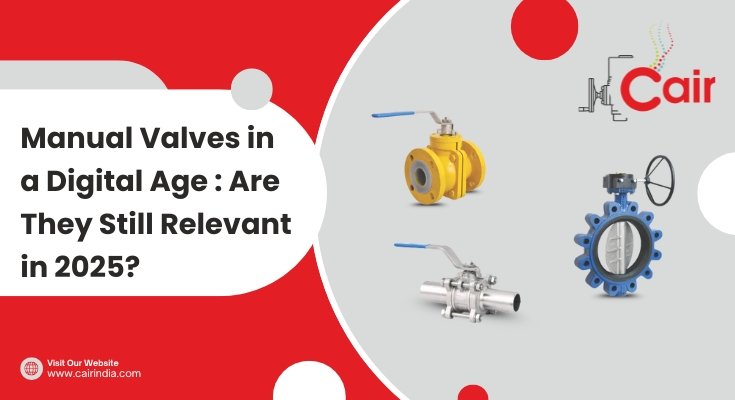
In recent years, the industrial world has seen a massive change towards automation and digital changes. From smart sensors to IIOT-enabled valve systems, automated technologies now dominate discussions around efficiency, safety, and real-time control. Plants and facilities in areas are embracing digital valves for their ability to basically integrate with advanced monitoring and remote operational systems.
However, this rapid development raises an important question: Is there still a place for manual valves in 2025? Although they may be old, they still serve as an inevitable solution in specific applications where automated systems may not be practical or cost-effective.
The Evolution of Industrial Valves
The history of industrial valves shows how technology has changed process control. Early systems relied on manual valves, which are powered by handwheels or a lever, valuable for their durability and ease of use. With increasing industrial demands, semi-automatic valves are being used, offering partial automation and reducing manual intervention.
Today, the focus has moved to smart and digital valves, which are basically integrated with the Industrial Internet of Things (IIOT). These advanced solutions enable real-time monitoring, future state maintenance, and distance operations. Nevertheless, the development of valve technology suggests that manual valves continue to play important roles in industries, while dominating automation in 2025.
Advantages of Manual Valves in 2025
Even in an era of automation, the benefits of manual valves make them indispensable in many industries. Their cost-effectiveness stands out-manual valves are far cheaper than digital options, making them ideal for small and medium-scale operations. They also provide simplicity and reliability with minimal moving parts and easy maintenance, ensuring long service life without the need for advanced technical skills.
Another benefit is their freedom from power or electronics, which makes them highly effective in manual valve applications such as a distance site, a dangerous environment, or an emergency backup system where automation may fail or may be impractical.
Where Automated and Digital Valves Outperform
While manual valves remain important, Automatic Valves vs. Manual Valves often offer benefits that traditional systems cannot compare. The biggest benefit is in real-time monitoring and control, allowing operators to instantly track pressure, flow and temperature.
Automated solutions also enable remote operation, which is important for large-scale plants and facilities spread over vast areas. Additionally, Smart Valve 2025 is designed to seamlessly integrate with SCADA and IIoT platforms, supporting predictive maintenance and process optimization. These capabilities make automatic valves the preferred choice in industries where efficiency, accuracy, and safety require more than manual intervention.
Industries Still Relying on Manual Valves
Despite the rise of automation, many industries still rely heavily on manual valves. In the Oil and Gas Area, manual valves, pipeline isolation, and emergency shutdowns, where quick human control is often safe. In Water treatment and irrigation, they provide reliable flow regulation without the requirement of complex digital systems.
Chemical and pharmaceutical industries also use manual valves in specific procedure controls where accuracy is required, but automation is not practical. For small and medium enterprises, manual valves remain the most cost-effective solution. This shows why manual valves for oil and gas and manual valves in water treatment remain highly relevant in 2025.
Challenges and Limitations of Manual Valves
While manual valves remain useful, they also come with clear shortcomings. One of the main manual valve boundaries is their labor-intensive operation, requiring physical efforts and presence on site. This can slow down processes, especially in large-scale plants. They also provide a slow response time compared to automated solutions, making them less efficient in industries where speed and precision are important.
Another challenge is their limited integration with the digital control system, which prohibits their role in highly automated features. These manual valve challenges highlight why many industries are rapidly transforming into automation, while still keeping manual valves as backups.
Future Outlook – Coexistence of Manual and Smart Valves
Looking forward, the future of the valve 2025 is not completely about changing manual valves, but finding a balance through coexistence. Many industries are adopting hybrid systems that combine the proven credibility of manual valves with the advanced intelligence of automated systems. In highly automated plants, manual valves continue to work as backup solutions, ensuring protection and excess during power failures or digital failures.
This approach helps in attacking businesses correctly, cost-balance using automation where it adds value while maintaining manual value where simplicity is sufficient.. Manual and digital valve cum-existence model will define industrial fluid control for years to come.
How to Select the Right Valve in 2025
Many factors need to be considered carefully to choose the right valve in today’s market. The decision between manual and automated solutions depends largely on applications, operating environment, budget, and safety requirements. For simple, cost-sensitive operations, manual valves can be ideal, while complex plants often benefit from digital solutions.
When choosing manual vs. digital valves, businesses should also assess long-term maintenance needs and energy efficiency targets. Consultation with expert manufacturers and suppliers is highly recommended, as they can provide an analog valve selection guide 2025, ensuring that the industries choose the most reliable, cost-effective, and prepared solutions for the future for their system.
Conclusion
In 2025, Manual valves in the modern industry continue holding their place, although their role is developing with digital technologies. While smart valves dominate the interaction around automation and IoT, manual valves remain unavoidable in areas where cost-effectiveness, simplicity, and credibility are the most case. They act as the necessary backup in automatic plants and provide unmatched value in a distant or dangerous environment.
To make the best option, industries should carefully evaluate their operational needs and consult reliable industrial valve suppliers in 2025. At Cair Euro Automation, we provide reliable solutions that balance tradition and innovation, which help businesses achieve efficiency, security, and long-term performance.